What Is a Lot in Forex? Understanding Trade Size for Beginners
A lot is the standard unit used to measure the size of a Forex trade. In this lesson, you will learn how standard, mini, micro, and nano lots work, how lot size affects pip value, and why selecting the correct trade size is essential for protecting your account.
Learning Outcomes
By the end of this lesson, you will be able to:
- Explain what a lot is in Forex trading.
- Understand standard, mini, micro, and nano lots.
- Recognise the number of currency units represented by each lot size.
- Understand how lot size affects pip value.
- Explain why larger trades create larger profits and losses.
- Avoid choosing trade sizes based only on potential profit.
- Prepare for the next lesson on position sizing.
Table of Contents
- What Is a Lot in Forex?
- Why Forex Uses Lots
- The Four Main Forex Lot Sizes
- Standard Lots Explained
- Mini Lots Explained
- Micro Lots Explained
- Nano Lots Explained
- How Lot Size Affects Pip Value
- Lot Size vs Position Size
- How Lot Size Affects Profit and Loss
- Choosing an Appropriate Lot Size
- Common Beginner Mistakes
- Frequently Asked Questions
- What Comes Next?
What Is a Lot in Forex?
A lot is the standard unit used to measure the size of a Forex trade.
When you trade Forex, you are not simply choosing whether a currency pair will rise or fall. You must also decide how much of that currency pair you want to buy or sell.
That trade quantity is expressed using lots.
You can think of a lot as a package containing a specific number of currency units. A standard lot contains a much larger number of units than a mini lot, while a micro lot contains fewer units than both.
Simple Example
Imagine two traders both buy EUR/USD at exactly the same price.
- Trader A opens a trade using 0.01 lots.
- Trader B opens a trade using 1.00 lot.
The market moves the same number of pips for both traders, but their financial results are very different.
Trader B controls a position that is 100 times larger than Trader A’s position. As a result, Trader B’s potential profit and potential loss are also approximately 100 times larger, assuming all other conditions are equal.
This is why understanding lot size is so important.
The direction of the market determines whether a trade wins or loses, but the lot size determines how strongly that movement affects your account.
Important Risk Warning
A larger lot size does not improve the quality of a trading setup. It only increases the amount of money gained or lost for each pip of movement.
Increasing trade size without considering account balance, stop-loss distance, and acceptable risk is one of the fastest ways to suffer serious losses.
Why Does Forex Use Lots?
The Forex market involves currencies being exchanged in very large quantities.
Banks, investment funds, corporations, governments, and individual traders all participate in the same global marketplace. To make trade quantities easier to describe and standardise, Forex positions are measured in lots rather than requiring traders to enter long currency-unit figures manually.
Instead of saying:
“I want to buy 100,000 units of EUR/USD,”
a trader can simply say:
“I want to buy one standard lot of EUR/USD.”
The two statements describe the same trade size.
Did You Know?
A Forex lot measures trade quantity, not the amount of cash physically removed from your account. The amount needed to open the position depends on the lot size, current market price, leverage, margin requirements, and your account currency.
The Four Main Forex Lot Sizes
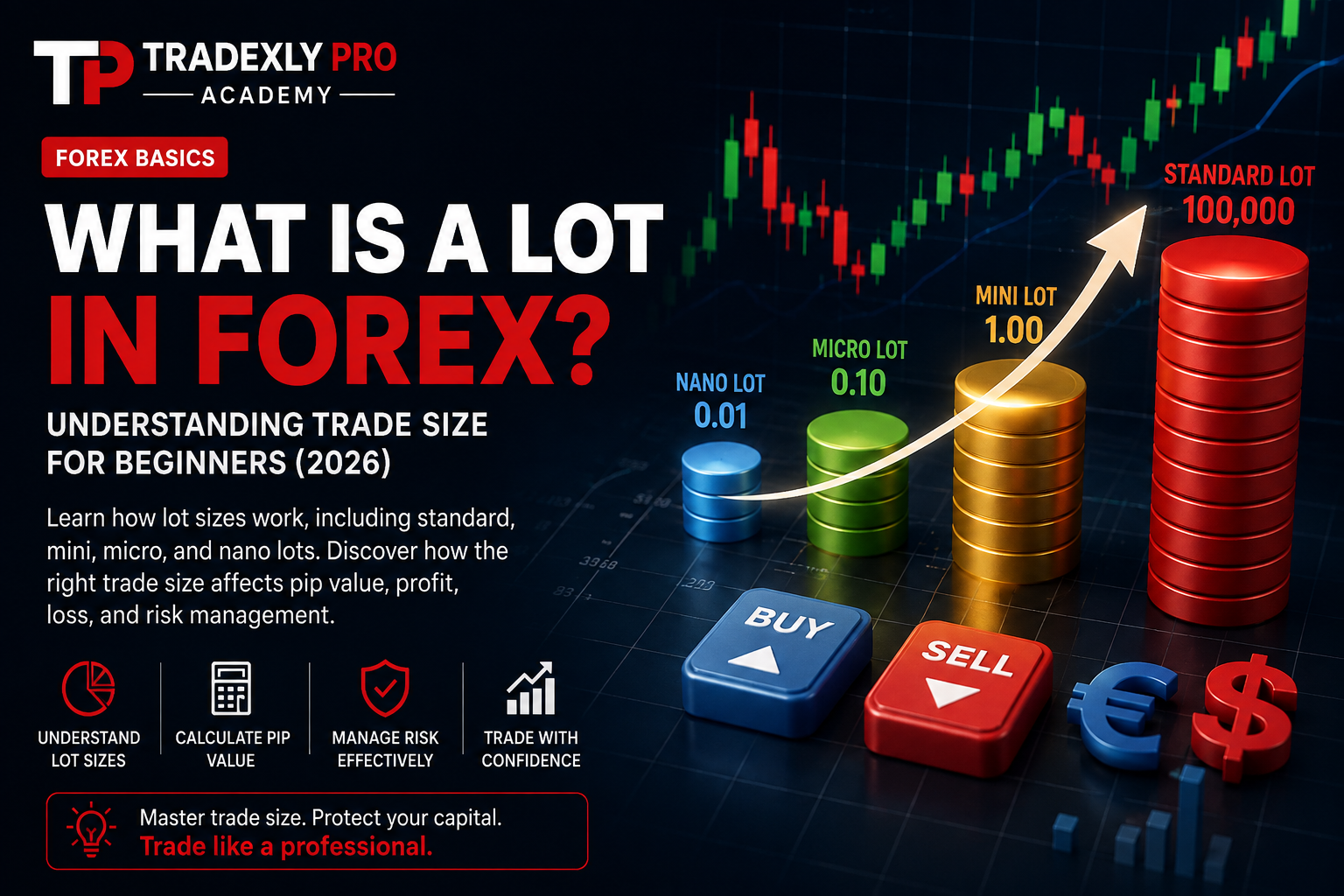
Forex lot sizes are generally divided into four main categories:
| Lot Type | Lot Size | Currency Units | Relative Size |
|---|---|---|---|
| Standard Lot | 1.00 | 100,000 units | Largest common retail size |
| Mini Lot | 0.10 | 10,000 units | One-tenth of a standard lot |
| Micro Lot | 0.01 | 1,000 units | One-hundredth of a standard lot |
| Nano Lot | 0.001 | 100 units | One-thousandth of a standard lot |
Quick Lot-Size Rule
- 1.00 lot = 100,000 currency units
- 0.10 lot = 10,000 currency units
- 0.01 lot = 1,000 currency units
- 0.001 lot = 100 currency units
Not every broker supports nano lots. Many retail Forex platforms allow trades beginning at 0.01 lots, while some offer smaller contract sizes.
What Is a Standard Lot?
A standard lot represents 100,000 units of the base currency in a Forex pair.
If you open a one-standard-lot position on EUR/USD, you are controlling 100,000 euros because the euro is the base currency.
If you open one standard lot of GBP/USD, you are controlling 100,000 British pounds.
Standard Lot Example
Currency pair: EUR/USD
Trade size: 1.00 lot
Position quantity: 100,000 euros
For many USD-quoted currency pairs, one pip on a standard lot is approximately $10. The exact value can vary depending on the pair, exchange rate, and account currency.
A standard lot creates substantial exposure. A movement of only 20 pips may represent approximately $200 of profit or loss on certain USD-quoted pairs.
For that reason, standard lots are generally unsuitable for small trading accounts unless the trader’s calculated risk and stop-loss distance justify the position.
Professional Insight
Experienced traders do not choose a standard lot because it sounds professional. They use it only when their account size, risk limit, stop-loss distance, and trading plan support that exposure.
Professional behaviour is defined by controlled risk—not by using the largest available trade size.
What Is a Mini Lot?
A mini lot represents 10,000 units of the base currency.
It is displayed on most trading platforms as 0.10 lots.
A mini lot is one-tenth of a standard lot. Therefore, its pip value is generally one-tenth of the pip value associated with a standard lot under equivalent conditions.
Mini Lot Example
Currency pair: EUR/USD
Trade size: 0.10 lots
Position quantity: 10,000 euros
Approximate value per pip on many USD-quoted pairs: $1 per pip
If the market moves 30 pips in your favour, a 0.10-lot position may generate approximately $30 before considering spreads, commissions, swaps, currency conversion, and other costs.
If the same market moves 30 pips against you, the approximate loss may also be $30.
What Is a Micro Lot?
A micro lot represents 1,000 units of the base currency.
It is normally displayed as 0.01 lots on a trading platform.
Micro lots provide much smaller exposure than standard or mini lots. They are often useful for beginners practising risk control, traders with smaller accounts, and experienced traders testing strategies with limited financial exposure.
Micro Lot Example
Currency pair: EUR/USD
Trade size: 0.01 lots
Position quantity: 1,000 euros
Approximate value per pip on many USD-quoted pairs: $0.10 per pip
A 50-pip movement would therefore represent approximately $5 on a 0.01-lot position under typical USD-quoted conditions.
Why Micro Lots Matter for Beginners
Micro lots allow beginners to experience live-market execution while keeping the financial impact of each pip relatively small.
However, using a micro lot does not automatically make a trade safe. Risk still depends on your account balance, stop-loss distance, number of open positions, market volatility, and overall trading plan.
What Is a Nano Lot?
A nano lot represents 100 units of the base currency and is commonly written as 0.001 lots.
Nano lots offer extremely small exposure and may be useful for highly controlled practice, testing, or very small account sizes.
However, nano lots are not available through every broker or account type. Some platforms have a minimum trade size of 0.01 lots.
Nano Lot Example
Currency pair: EUR/USD
Trade size: 0.001 lots
Position quantity: 100 euros
Approximate value per pip on many USD-quoted pairs: $0.01 per pip
Comparing Forex Lot Sizes
| Trade Size | Units Controlled | Approximate Pip Value* | 20-Pip Movement* |
|---|---|---|---|
| 1.00 lot | 100,000 | $10 per pip | $200 |
| 0.10 lots | 10,000 | $1 per pip | $20 |
| 0.01 lots | 1,000 | $0.10 per pip | $2 |
| 0.001 lots | 100 | $0.01 per pip | $0.20 |
*These simplified examples apply approximately to many currency pairs where USD is the quote currency. Actual pip value depends on the currency pair, market price, account denomination, and trade size.
Do Not Treat Every Pip as a Fixed Dollar Amount
The common values of $10, $1, $0.10, and $0.01 per pip are useful beginner examples, but they are not universal.
Pip values can differ for JPY pairs, cross-currency pairs, accounts denominated in other currencies, and instruments with different contract specifications.
Before continuing, review What Is a Pip? if you need a refresher on how Forex price movements are measured.
You should also understand what the Forex spread is, because spreads and commissions affect the final cost and outcome of every position you open.
How Lot Size Affects Pip Value
Lot size and pip value are closely connected.
A pip measures how far the market has moved, while lot size determines how much that movement is worth to your trade.
The larger your position, the greater the financial effect of every pip.
Example: The Same Market Movement with Different Lot Sizes
Imagine EUR/USD moves by 25 pips.
| Trade Size | Approximate Pip Value | Approximate Result After 25 Pips |
|---|---|---|
| 1.00 lot | $10 per pip | $250 profit or loss |
| 0.10 lots | $1 per pip | $25 profit or loss |
| 0.01 lots | $0.10 per pip | $2.50 profit or loss |
| 0.001 lots | $0.01 per pip | $0.25 profit or loss |
The market moved exactly the same 25 pips in every example.
The only difference was the lot size.
This demonstrates one of the most important principles in Forex trading:
The market controls how far price moves, but you control how much that movement affects your account.
Professional Insight
Experienced traders do not increase lot size simply because they feel confident about a trade.
Confidence does not reduce market risk.
A disciplined trader chooses position size using a predefined risk percentage and a logical stop-loss distance. This makes the decision measurable rather than emotional.
Lot Size vs Position Size: Are They the Same?
The terms lot size and position size are often used interchangeably, but there is a useful distinction.
Lot size refers to the standard measurement used to express trade quantity, such as 1.00, 0.10, or 0.01 lots.
Position size refers more broadly to the total exposure of your trade and how that exposure fits within your risk plan.
Simple Comparison
- Lot size: The quantity entered into the trading platform.
- Position size: The trade quantity selected after considering risk, account balance, stop-loss distance, and pip value.
For example, entering 0.10 lots tells the broker how large the trade should be.
Deciding whether 0.10 lots is appropriate requires a position-sizing calculation.
That calculation will be covered in the next Tradexly Pro Academy lesson.
Remember This
A lot is the unit used to express trade size.
Position sizing is the risk-management process used to decide which lot size is appropriate.
How Lot Size Affects Profit and Loss
Lot size directly determines how quickly your account balance can rise or fall when the market moves.
A larger position creates larger potential profits, but it also creates equally large potential losses.
Forex beginners are often attracted to large lot sizes because the potential returns appear exciting. However, the same exposure works against the trader when the market moves in the opposite direction.
Example: A 40-Pip Winning Trade
| Lot Size | Approximate Pip Value | Approximate Profit |
|---|---|---|
| 1.00 | $10 | $400 |
| 0.10 | $1 | $40 |
| 0.01 | $0.10 | $4 |
Example: A 40-Pip Losing Trade
| Lot Size | Approximate Pip Value | Approximate Loss |
|---|---|---|
| 1.00 | $10 | $400 |
| 0.10 | $1 | $40 |
| 0.01 | $0.10 | $4 |
The tables are nearly identical because lot size magnifies both gains and losses.
This is why responsible traders never evaluate a trade only by asking:
“How much could I make?”
They also ask:
“How much could I lose if this trade reaches my stop loss?”
Large Profit Potential Always Comes with Large Loss Potential
There is no lot size that increases profit without also increasing risk.
Whenever you increase position size, you increase the monetary value of every pip in both directions.
Why Beginners Often Use Too Much Lot Size
One of the most common causes of early trading losses is using a position that is too large for the account.
This often happens because beginners focus on potential profit rather than acceptable risk.
A new trader may see that a one-standard-lot position can produce approximately $10 per pip and imagine earning hundreds of dollars from a relatively small market movement.
What is often overlooked is that a 50-pip move against the trade could also create an approximate $500 loss.
On a small account, that single trade could cause severe damage.
Common Thought Process
“If I use a larger lot size, I can make money faster.”
Professional Thought Process
“I will calculate how much I can afford to lose first, then choose the lot size that keeps the trade within that limit.”
This difference in thinking is fundamental.
Professional trading begins with risk control, not profit prediction.
Does Account Balance Determine Lot Size?
Account balance is an important factor, but it should never be used alone to select trade size.
Two traders with the same account balance may need completely different lot sizes because their stop-loss distances and risk limits may differ.
Example
Trader A has a $1,000 account and uses a 20-pip stop loss.
Trader B also has a $1,000 account but uses a 100-pip stop loss.
If both traders want to risk the same percentage of their accounts, Trader B must use a smaller lot size because the stop loss is five times wider.
This demonstrates why lot size cannot be chosen from account balance alone.
A proper calculation normally considers:
- Account balance or equity.
- Percentage of the account you are willing to risk.
- Stop-loss distance in pips.
- Pip value for the selected currency pair.
- Account currency.
Professional Insight
There is no universal “best lot size” for a $100, $1,000, or $10,000 account.
The appropriate trade size changes with the setup, stop-loss distance, currency pair, and risk limit.
How Leverage Relates to Lot Size
Lot size and leverage are connected, but they are not the same thing.
Lot size determines the quantity of currency you control.
Leverage allows you to control that larger position using a smaller amount of your own account funds as margin.
Simple Illustration
A standard lot controls 100,000 units of the base currency.
Without leverage, controlling such a position could require a very large amount of capital.
With leverage, the broker may require only a percentage of the full position value as margin.
However, leverage does not reduce the financial effect of the lot size.
If a one-standard-lot position has an approximate pip value of $10, that value does not become smaller simply because leverage was used.
Leverage Can Make Oversized Trades Look Affordable
A broker may allow you to open a large position with relatively little margin, but that does not mean the position is appropriate for your account.
Margin determines whether the platform allows the trade. Risk management determines whether you should take it.
Leverage and margin will be covered in dedicated Academy lessons so that each concept can be understood properly without overcrowding this lesson.
How to Choose an Appropriate Lot Size
The safest way to select a lot size is to work backwards from risk.
Instead of choosing a trade size first and hoping the potential loss is acceptable, decide how much you are willing to lose before entering the position.
A disciplined process looks like this:
- Determine your account balance or equity.
- Choose the maximum percentage you are willing to risk.
- Identify a logical stop-loss level.
- Measure the stop-loss distance in pips.
- Calculate the lot size that keeps the potential loss within your risk limit.
Risk Comes Before Lot Size
Never begin by asking, “What lot size should I use?”
Begin by asking, “How much of my account am I prepared to risk if this trade fails?”
Basic Risk Example
Account balance: $2,000
Maximum risk: 1%
Maximum acceptable loss: $20
Stop-loss distance: 40 pips
The trader needs a position where each pip is worth approximately $0.50, because:
$20 ÷ 40 pips = $0.50 per pip
On many USD-quoted pairs, that may correspond approximately to 0.05 lots.
This is a simplified educational example. Exact position size depends on the currency pair, current exchange rate, account currency, and contract specifications.
Should Beginners Always Use Micro Lots?
Micro lots can be useful for beginners because they reduce the financial value of each pip.
However, saying that every beginner should always use exactly 0.01 lots would be misleading.
For some accounts and stop-loss distances, 0.01 lots may still risk too much.
For larger accounts, a carefully calculated position may be greater than 0.01 lots while still remaining within a conservative risk limit.
What Really Makes a Trade Size Safe?
Safety does not come from the lot-size label alone.
It comes from the relationship between lot size, stop-loss distance, pip value, account size, and total risk.
Can You Open Multiple Trades Using Different Lot Sizes?
Yes.
A trader can hold multiple positions with different lot sizes, provided the trading platform, account type, available margin, and broker rules allow it.
However, the risk of every open trade must be considered together.
Combined Exposure Example
- EUR/USD position: 0.05 lots
- GBP/USD position: 0.05 lots
- AUD/USD position: 0.05 lots
Although each position may look small individually, the combined exposure is 0.15 lots.
The risk may be even greater if all three positions depend on the US dollar moving in the same direction.
Professional Insight
Experienced traders measure total account exposure rather than examining each position in isolation.
Several small trades can collectively create the same risk as one large trade.
Common Beginner Mistakes with Lot Size
1. Choosing Lot Size Based on Desired Profit
Many beginners decide how much money they want to make, then select a lot size that could produce that profit quickly.
This reverses the correct process.
Trade size should be based on acceptable risk, not desired reward.
2. Using the Same Lot Size on Every Trade
Different trades have different stop-loss distances.
Using the same lot size on a 20-pip stop and a 100-pip stop creates very different levels of risk.
The wider the stop loss, the smaller the position may need to be if the trader wants to maintain the same monetary risk.
3. Assuming a Small Lot Size Is Automatically Safe
A trade of 0.01 lots may appear small, but it can still be inappropriate for a very small account or an extremely wide stop loss.
The lot size must always be evaluated in relation to the account and trade setup.
4. Increasing Lot Size After a Loss
Some traders respond to a losing trade by increasing the next position size in an attempt to recover the loss quickly.
This behaviour is often called revenge trading and can rapidly increase account damage.
Each trade should be sized independently according to the trading plan.
5. Copying Another Trader’s Lot Size
A lot size that is appropriate for one trader may be dangerous for another.
Different traders have different account balances, risk limits, stop-loss distances, account currencies, and overall exposure.
Copying a trade size without understanding the calculation behind it is not responsible risk management.
6. Ignoring Other Open Positions
A trader may calculate one position correctly but forget that several other trades are already open.
The combined risk of all open positions can be much larger than expected, especially when several trades are correlated.
Lesson Summary
- A lot is the standard unit used to measure Forex trade size.
- One standard lot represents 100,000 units of the base currency.
- One mini lot represents 10,000 units.
- One micro lot represents 1,000 units.
- One nano lot represents 100 units, although not every broker supports it.
- Lot size determines the financial value of each pip.
- Larger positions increase both potential profit and potential loss.
- Lot size should be selected from acceptable risk, not desired profit.
- Account balance alone is not enough to determine an appropriate trade size.
- Stop-loss distance, pip value, account currency, and total exposure must also be considered.
Practice Exercise
Open a demo trading platform and locate the order-entry window for EUR/USD.
Without placing a trade, enter each of the following values into the volume or lot-size field:
- 1.00
- 0.10
- 0.01
Observe whether the platform displays any changes to:
- Required margin.
- Estimated pip value.
- Potential profit and loss.
- Position quantity.
Then answer these questions:
- Which trade size controls the greatest number of currency units?
- Which trade size would create the largest financial effect for each pip?
- Would the largest available trade size necessarily be appropriate for your account?
- What information would you need before choosing the correct lot size?
Practice Safely
Use a demo account for this exercise.
The purpose is to understand how changing lot size changes exposure—not to open the largest possible position.
Frequently Asked Questions
What is a lot in Forex?
A lot is the standard unit used to measure the size of a Forex position. It tells the broker how many units of the base currency you want to buy or sell.
How many units are in one standard lot?
One standard lot usually represents 100,000 units of the base currency.
What is 0.10 lots in Forex?
A trade size of 0.10 lots is known as one mini lot and usually represents 10,000 units of the base currency.
What is 0.01 lots in Forex?
A trade size of 0.01 lots is one micro lot and normally represents 1,000 units of the base currency.
What is the safest lot size for beginners?
There is no single lot size that is safe for every beginner.
The appropriate size depends on account balance, risk percentage, stop-loss distance, pip value, account currency, and total open exposure.
Micro lots may be useful for many beginners, but the position should still be calculated properly.
Is lot size the same as leverage?
No.
Lot size determines the quantity of the position, while leverage affects how much margin is required to control that position.
Does a larger lot size mean more profit?
A larger lot size increases the financial effect of every pip. This can create more profit when the market moves in your favour, but it also creates larger losses when the market moves against you.
Can I change lot size after opening a trade?
Most platforms do not allow you to directly edit the size of an existing position.
Depending on the platform and broker, you may be able to partially close the trade or open an additional position. The exact options depend on the account and execution model.
Why does pip value change between currency pairs?
Pip value depends on the trade size, currency pair, current exchange rate, quote currency, and account denomination.
This is why the simplified $10-per-pip example for a standard lot does not apply identically to every pair.
Build Your Forex Knowledge Step by Step
Understanding lot size is essential because it connects market movement to real financial risk.
The free Tradexly Pro Starter Program gives beginners a structured path through the fundamentals of Forex trading, practical education, trusted resources, and guidance for taking the next step responsibly.