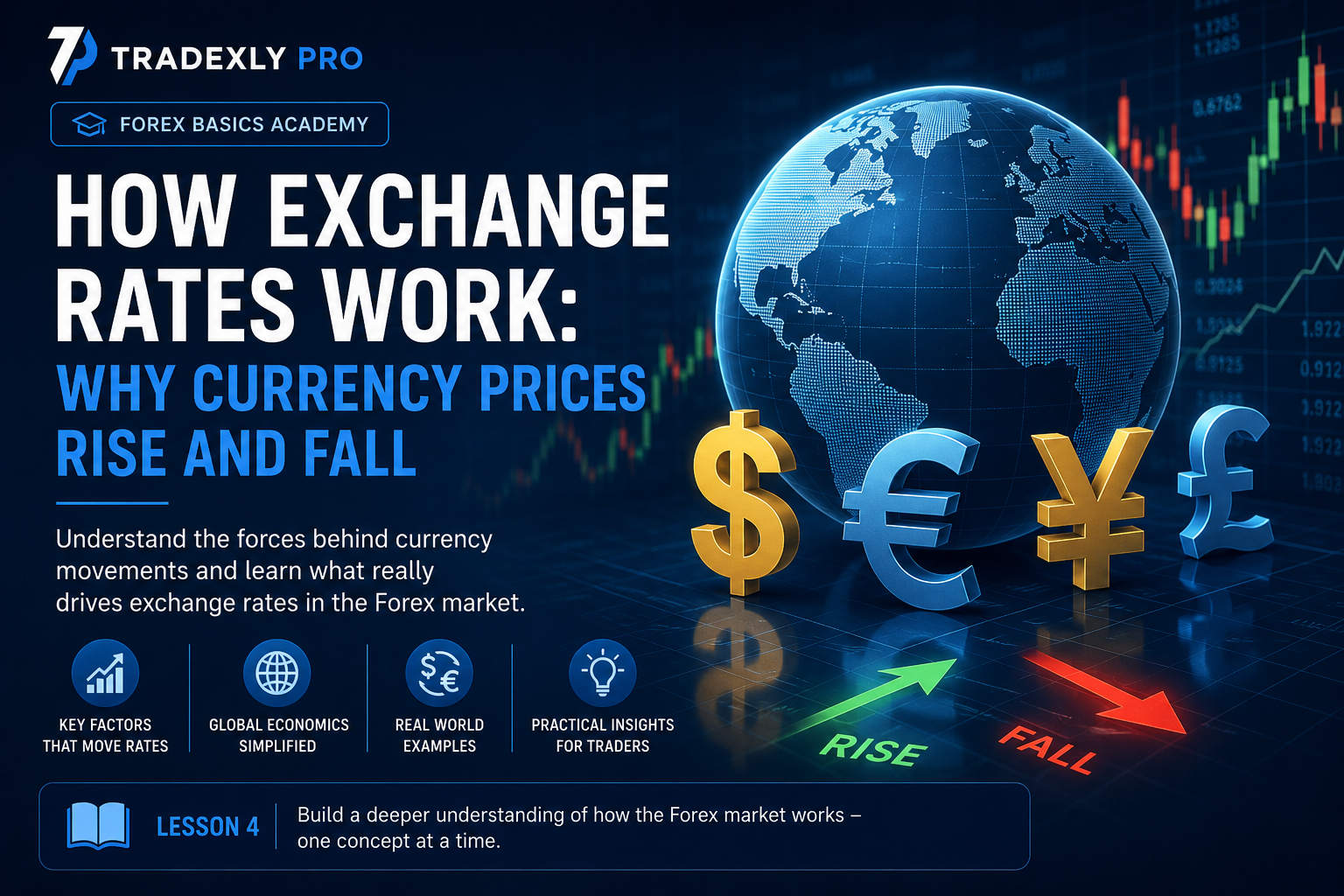
How Exchange Rates Work: Why Currency Prices Rise and Fall
Discover what exchange rates are, why they constantly change, and how these price movements create opportunities in the global forex market.
- Understand what an exchange rate is.
- Explain why exchange rates constantly change.
- Identify the major forces that move currency prices.
- Understand the relationship between supply and demand in Forex.
- Prepare for learning pips, spreads, leverage, and price movement.
Table of Contents
- What Are Exchange Rates?
- Why Exchange Rates Matter
- How Exchange Rates Are Determined
- Supply and Demand Explained
- The Main Factors That Move Currency Prices
- Floating vs Fixed Exchange Rates
- Real-World Examples
- Common Beginner Mistakes
- Frequently Asked Questions
- Next Lesson
What Are Exchange Rates?
Every time you see a currency pair like EUR/USD, GBP/USD, or USD/JPY, you’re looking at an exchange rate. An exchange rate simply tells you how much one currency is worth compared to another currency. In other words, it answers one simple question: “How much of Currency B do I need to buy one unit of Currency A?”
For example, imagine the EUR/USD exchange rate is trading at 1.1700. This means that one euro is worth 1.17 US dollars. It does not mean the euro has a fixed value everywhere in the world. Instead, it represents the current market value determined by millions of buyers and sellers participating in the foreign exchange market every second.
Example
EUR/USD = 1.1700
- 1 Euro = 1.17 US Dollars
- 10 Euros = 11.70 US Dollars
- 100 Euros = 117 US Dollars
- 1,000 Euros = 1,170 US Dollars
Every currency pair works exactly the same way. The only thing that changes is which currency appears first and which appears second. If you haven’t already, read our previous lesson on Currency Pairs Explained: Major, Minor & Exotic Pairs. It explains why currencies are always quoted in pairs and how to interpret them correctly.
Why Do Exchange Rates Matter?
Exchange rates influence far more than just Forex trading. They affect international travel, online shopping, imports and exports, business profits, inflation, central bank decisions, investment returns, and even the prices consumers pay every day. In fact, every country that trades with another country depends on exchange rates.
Imagine you own a company in Germany that imports electronics from the United States. If the US dollar becomes stronger against the euro, your company must spend more euros to purchase the same products. If the dollar weakens, importing those products becomes cheaper. This simple example demonstrates why governments, multinational corporations, investors, and banks monitor exchange rates continuously.
Did You Know?
The foreign exchange market processes trillions of dollars in transactions every day, making it the largest and most liquid financial market in the world. Unlike stock markets, Forex operates 24 hours a day during the trading week because major financial centres around the world open and close at different times.
How Are Exchange Rates Determined?
One of the biggest misconceptions among beginners is believing that governments simply decide what a currency is worth. While governments and central banks can influence exchange rates, most major currencies are actually priced by the market itself. Every second, millions of participants are buying and selling currencies. These participants include:
- Commercial banks
- Central banks
- Investment funds
- Governments
- Multinational corporations
- Importers and exporters
- Institutional investors
- Retail Forex traders
Whenever more people want to buy a currency than sell it, demand increases and the exchange rate tends to rise. Whenever more people want to sell a currency than buy it, supply increases and the exchange rate tends to fall. This relationship between buyers and sellers is the foundation of every price movement you see on a Forex chart.
Professional Insight
Professional traders rarely ask, “Will EUR/USD go up?” Instead, they ask, “Why would institutions want to buy euros today?” Understanding the reason behind market movement is often more valuable than simply predicting the direction.
Supply and Demand: The Engine Behind Every Exchange Rate
At its core, the Forex market operates on the same economic principle that influences the price of nearly every product or service: supply and demand. Think of a popular concert with a limited number of tickets. If thousands of people want those tickets but only a few are available, the price rises because demand exceeds supply. Currencies behave in a very similar way. When global investors, businesses, and financial institutions all want to buy a particular currency, its value tends to increase. When more participants want to sell that currency than buy it, its value generally decreases.
The Main Factors That Move Exchange Rates
If supply and demand determine the price of a currency, what causes supply and demand to change in the first place? The answer lies in economic data, central bank decisions, global events, and investor confidence. Professional traders don’t simply watch charts—they pay close attention to the economic forces that influence buying and selling decisions across the world. Let’s look at the most important factors that move exchange rates.
| Factor | What Happens? | Typical Effect on Currency |
|---|---|---|
| Interest Rates | Higher interest rates attract foreign investment. | Usually strengthens the currency. |
| Inflation | Lower inflation preserves purchasing power. | Usually strengthens the currency. |
| Economic Growth | Strong GDP and business activity increase confidence. | Often strengthens the currency. |
| Employment Data | Strong labour markets suggest a healthy economy. | Can increase demand for the currency. |
| Political Stability | Stable governments attract investors. | Usually supports the currency. |
| Central Bank Policy | Interest rate decisions and monetary policy influence expectations. | Often causes significant market movement. |
| Market Sentiment | Fear or optimism changes investor behaviour. | Can rapidly move exchange rates. |
Remember This
Exchange rates rarely move because of a single event. Most currency movements are the result of several economic factors working together while millions of market participants constantly adjust their expectations.
1. Interest Rates
Interest rates are one of the most powerful drivers of exchange rates. Central banks set interest rates to help control inflation and support economic growth. When a country’s interest rates rise, investors from around the world often move their money into that country’s financial assets to earn higher returns. To invest, they first need to buy that country’s currency. As demand increases, the currency often becomes stronger.
Example
Imagine the United States raises interest rates while the Eurozone keeps rates unchanged. Many investors may move their money into US investments to earn the higher return. To do this, they need US dollars. Demand for USD increases, causing the dollar to strengthen against many other currencies.
Important Note
Markets usually react to expectations rather than the announcement itself. If traders already expect an interest rate increase, much of the price movement may happen before the official decision is released.
2. Inflation
Inflation measures how quickly prices for goods and services are rising. A country with low and stable inflation generally maintains stronger purchasing power than one experiencing high inflation. Lower inflation often leads to greater investor confidence because money retains more of its value over time. This can increase demand for that country’s currency.
Real-World Comparison
Country A has annual inflation of 2%. Country B has annual inflation of 15%. Over time, investors are generally more comfortable holding the currency of Country A because it loses purchasing power much more slowly.
3. Economic Growth (GDP)
Economic growth is commonly measured using Gross Domestic Product (GDP). When businesses are expanding, consumers are spending, unemployment is falling, and production is increasing, the economy is generally considered healthy. Strong economies often attract international investment, increasing demand for the national currency. However, markets don’t simply react to whether GDP is positive or negative—they compare actual results with what economists expected. Even a growing economy can weaken its currency if growth disappoints market expectations.
Professional Insight
Professional traders focus less on today’s news and more on whether the news is better or worse than expected. Markets price expectations—not just facts.
4. Employment Data
Employment reports provide insight into the health of an economy. When more people have jobs, they generally spend more money, businesses grow faster, and tax revenues increase. One of the most closely watched reports in the Forex market is the United States Non-Farm Payrolls (NFP) report, released on the first Friday of most months. Large surprises in employment data often create significant volatility in currency markets.
Did You Know?
Some of the largest single-day movements in major currency pairs occur immediately after important economic reports such as Non-Farm Payrolls, inflation data, or central bank interest rate decisions.
5. Political Stability and Global Events
Currencies perform best when investors have confidence in a country’s future. Political instability, wars, elections, natural disasters, trade disputes, or unexpected government policies can reduce investor confidence and encourage capital to leave the country. As investors sell the currency, exchange rates may decline. On the other hand, political stability often encourages long-term investment and supports currency strength.
Example
If investors become concerned that political uncertainty could harm a country’s economy, they may move their investments elsewhere. As they sell that country’s currency to buy another, demand falls and the exchange rate may weaken.
6. Central Banks
Central banks play a crucial role in influencing exchange rates. Although they don’t directly control floating exchange rates, they influence market expectations through monetary policy. Some of the world’s most influential central banks include:
- Federal Reserve (United States)
- European Central Bank (Eurozone)
- Bank of England (United Kingdom)
- Bank of Japan (Japan)
- Swiss National Bank (Switzerland)
- Reserve Bank of Australia (Australia)
Whenever these institutions announce interest rate decisions, publish economic forecasts, or hold press conferences, the Forex market often reacts immediately. For this reason, experienced traders closely monitor central bank calendars before opening positions.
Floating vs. Fixed Exchange Rates
Not every country allows its currency to move freely in the foreign exchange market. While most of the world’s major currencies operate under a floating exchange rate system, some governments choose to manage or fix the value of their currency against another currency. Understanding the difference between these systems helps explain why some currencies move dramatically every day while others remain relatively stable.
| Floating Exchange Rate | Fixed Exchange Rate |
|---|---|
| Determined by market supply and demand. | Maintained by the country’s central bank or government. |
| Changes continuously throughout the trading day. | Moves very little unless officially adjusted. |
| Common among major developed economies. | Common in some developing or oil-dependent economies. |
| Can be more volatile. | Generally more stable but requires government intervention. |
| Creates more trading opportunities. | Usually offers fewer opportunities for large price movements. |
Did You Know?
Most currency pairs traded by Forex traders—such as EUR/USD, GBP/USD, USD/JPY, AUD/USD, and USD/CAD—operate under floating exchange rate systems. This is one of the reasons they experience continuous price movements throughout the trading day.
Currency Appreciation vs. Currency Depreciation
As you follow the Forex market, you’ll often hear analysts say that a currency has appreciated or depreciated. These are simply technical terms describing whether a currency has become stronger or weaker compared to another currency.
| Term | Meaning | Example |
|---|---|---|
| Appreciation | A currency gains value relative to another currency. | EUR/USD rises from 1.1500 to 1.1800. |
| Depreciation | A currency loses value relative to another currency. | EUR/USD falls from 1.1800 to 1.1500. |
Remember that every Forex transaction involves two currencies. If one currency strengthens, the other weakens relative to it. This is why Forex traders always analyze the strength of both currencies in a pair instead of looking at only one currency in isolation.
Example
Suppose EUR/USD is trading at 1.1200. Later in the day it rises to 1.1300. This means the euro has appreciated against the US dollar because one euro now buys more dollars than before. Conversely, the US dollar has depreciated relative to the euro.
Why Exchange Rates Change Every Second
One of the first questions many beginners ask is: “Why does the price keep moving even when there is no major news?” The answer is surprisingly simple. The Forex market is constantly processing new information. Every second, banks, investment funds, multinational corporations, governments, hedge funds, and retail traders place buy and sell orders. Each new order affects the balance between supply and demand. Because millions of these transactions occur around the world every day, exchange rates are continuously adjusting to reflect the latest market conditions.
Some movements are caused by major economic announcements. Others result from large institutional trades, changing investor expectations, geopolitical developments, or shifts in global risk sentiment. Even when there is no obvious headline, the market is still responding to countless decisions made by participants across the globe.
Professional Insight
Professional traders understand that markets don’t wait for news—they constantly anticipate it. Prices often begin moving before an announcement because institutional investors are positioning themselves based on what they expect to happen. By the time the news is released, much of the move may already have occurred.
How Forex Traders Use Exchange Rate Movements
Understanding why exchange rates move is only the first step. Successful traders use that knowledge to make informed trading decisions rather than relying on guesswork. Before entering a trade, experienced traders often ask questions such as:
- Which currency appears fundamentally stronger?
- Are interest rates expected to rise or fall?
- What economic reports are scheduled this week?
- Is inflation increasing or decreasing?
- What is the current market sentiment?
- Are central banks expected to change monetary policy?
By combining these fundamental factors with technical analysis, traders develop a more complete understanding of why prices may move in a particular direction. This is one of the biggest differences between gambling and professional trading. Professional traders look for evidence—not certainty.
Important Reminder
No single economic indicator guarantees that a currency will rise or fall. The Forex market is influenced by many factors simultaneously, and unexpected events can always change market direction. Good traders focus on probabilities and disciplined risk management rather than trying to predict every movement perfectly.
Common Beginner Mistakes
1. Believing News Alone Moves the Market
News is important, but markets also react to expectations, positioning, and investor sentiment. Sometimes positive news can even cause prices to fall if traders expected an even better outcome.
2. Ignoring the Second Currency
Many beginners only analyse one side of a currency pair. Always remember that Forex compares two economies. Both currencies matter equally.
3. Thinking Exchange Rates Move Randomly
Price movements may appear random on short timeframes, but exchange rates generally reflect changing economic conditions, supply and demand, and investor expectations. Understanding these relationships helps traders make more informed decisions.
4. Forgetting That Expectations Drive Markets
Markets often move based on what traders expect to happen rather than what has already happened. Learning to interpret expectations is an important step toward becoming a more advanced trader.
Key Takeaways
- Exchange rates represent the value of one currency compared with another.
- Supply and demand determine currency prices in the Forex market.
- Interest rates, inflation, GDP, employment, central banks, politics, and market sentiment all influence exchange rates.
- Currencies appreciate when demand increases and depreciate when demand falls.
- Successful traders analyse both economic fundamentals and market psychology before making trading decisions.
Frequently Asked Questions (FAQs)
What is an exchange rate?
An exchange rate is the value of one currency compared to another. It tells you how much of one currency is needed to purchase one unit of another currency. For example, if EUR/USD is trading at 1.1700, one euro is worth 1.17 US dollars.
Why do exchange rates constantly change?
Exchange rates change because millions of buyers and sellers participate in the foreign exchange market every day. As supply and demand change due to economic news, interest rates, political events, investor sentiment, and global trade, currency prices adjust almost instantly.
Who determines exchange rates?
For most major currencies, exchange rates are determined by the market itself through supply and demand. Although central banks influence currencies through monetary policy, they generally do not directly set the value of floating currencies like the US dollar, euro, British pound, or Japanese yen.
Why are interest rates important in Forex?
Higher interest rates often attract international investors seeking better returns on their investments. This increases demand for that country’s currency, which can strengthen its value relative to other currencies.
Can exchange rates be predicted?
No one can predict exchange rates with complete accuracy. Professional traders analyse economic data, technical charts, market sentiment, and risk management to improve the probability of making successful trading decisions.
Why do traders monitor economic news?
Economic reports such as inflation, employment, GDP growth, and central bank announcements provide valuable information about the health of an economy. These reports often influence investor expectations and can lead to significant movements in exchange rates.
Take the Next Step with the Tradexly Pro Starter Program
Now that you understand how exchange rates work, you’re ready to start building practical trading skills. Our free Tradexly Pro Starter Program is designed to help beginners move from theory to confident trading by providing structured lessons, practical guidance, trusted broker recommendations, and exclusive educational resources.
Whether you’re completely new to Forex or looking to strengthen your foundation, the Starter Program will help you progress through the Academy in the correct order.