What Is the Bid Price and Ask Price? Understanding How Forex Trades Are Executed
Every Forex trade begins with two prices. In this lesson, you’ll learn what the Bid Price and Ask Price mean, why they exist, and how understanding them will help you place smarter trades.
By the end of this lesson, you’ll be able to:
- Explain the difference between the Bid Price and Ask Price.
- Understand why every Forex quote contains two prices.
- Know what happens when you click Buy or Sell.
- Read currency quotes on popular trading platforms.
- Prepare for the next lesson on spreads.
Table of Contents
- Why Are There Two Prices?
- What Is the Bid Price?
- What Is the Ask Price?
- How Buy and Sell Orders Work
- Reading Forex Quotes
- Real Trading Examples
- Common Beginner Mistakes
- FAQs
- What’s Next?
Imagine You’re About to Place Your First Forex Trade…
You’ve opened your trading platform. You select the EUR/USD currency pair. Instead of seeing one price, you notice two. One price is labelled Bid. The other is labelled Ask. Your first thought is probably: “Why are there two prices for the same currency pair?” It’s a great question—and one that almost every new trader asks. Fortunately, the answer is much simpler than it appears. Once you understand the purpose of the Bid Price and Ask Price, you’ll also understand why every Forex trade starts with a small cost and why the market behaves the way it does.
Did You Know?
Whether you’re trading through MetaTrader 4, MetaTrader 5, TradingView, cTrader, or another platform, you’ll always see two prices for every currency pair. This isn’t a platform feature—it’s how the Forex market itself operates.
Why Does Every Currency Pair Have Two Prices?
Think about buying and selling a car. If a dealership is selling a car for €20,000, they probably won’t buy the same car back from you for exactly €20,000. Instead, they’ll offer a slightly lower price. The difference between the buying price and the selling price allows the dealership to make a profit. The Forex market works in a similar way. Every currency pair has:
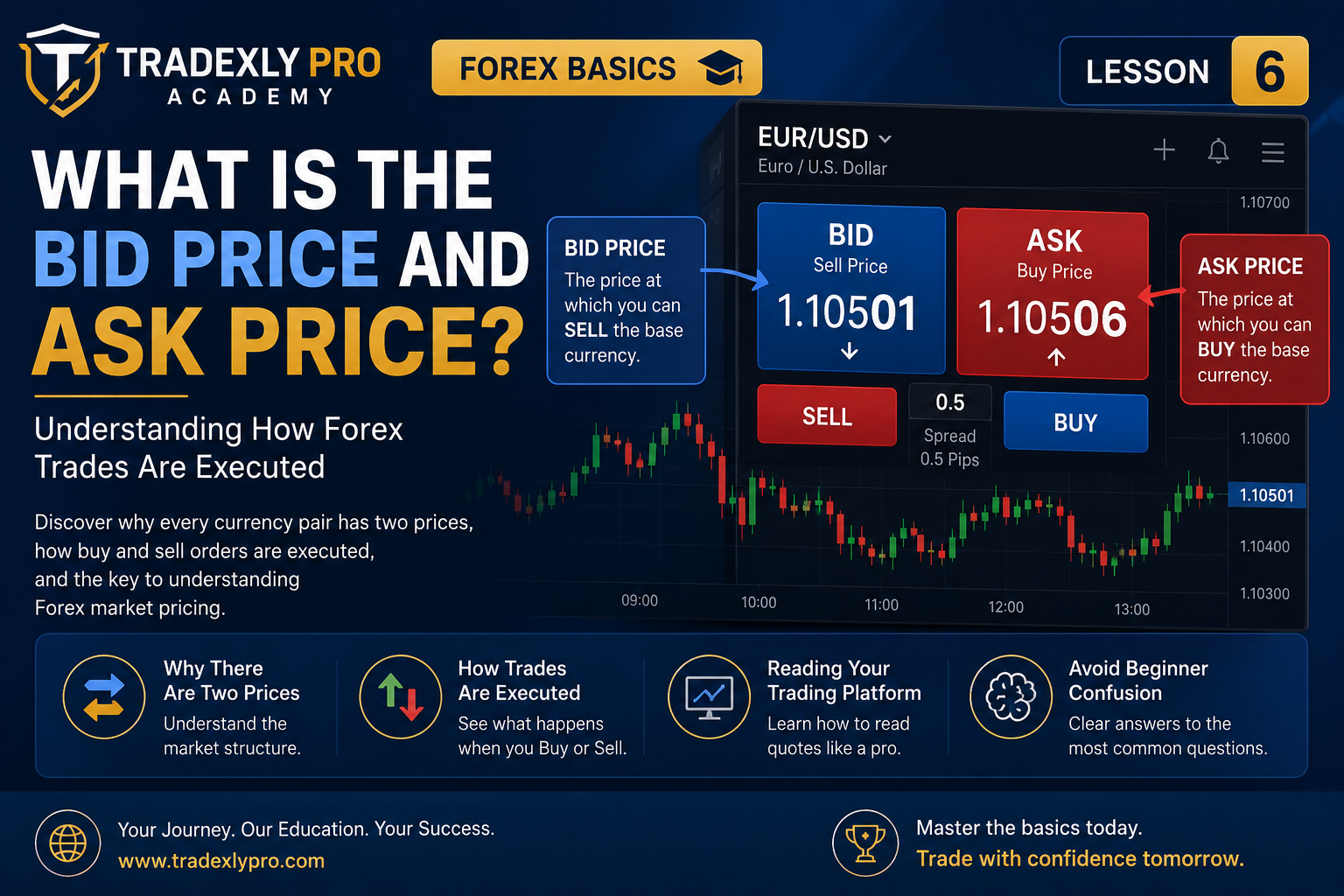
- Bid Price — the price at which you can sell the base currency.
- Ask Price — the price at which you can buy the base currency.
Because buying and selling are different transactions, they occur at slightly different prices. That’s why every Forex quote displays two numbers instead of one.
Example
EUR/USD
- Bid: 1.1050
- Ask: 1.1052
If you want to buy EUR/USD, your trade is executed at the Ask Price (1.1052). If you want to sell EUR/USD, your trade is executed at the Bid Price (1.1050).
Important
Many beginners think the trading platform is making a mistake because they expected only one price. In reality, seeing two prices is completely normal and is how every professional trading platform displays the market.
What Is the Bid Price?
The Bid Price is the highest price that buyers in the market are currently willing to pay for the base currency. Another way to think about it is this: If you decide to sell a currency pair, your order will usually be executed at the Bid Price. For example, if EUR/USD is quoted as:
- Bid: 1.1050
- Ask: 1.1052
Clicking the Sell button means you’re accepting the highest buying price currently available in the market—1.1050.
Easy Way to Remember
Think of the Bid Price as the market saying: “This is the price we’re willing to pay if you want to sell.”
What Is the Ask Price?
The Ask Price is the lowest price that sellers are currently willing to accept for the base currency. Whenever you click the Buy button, your trade is executed at the Ask Price. Using the same EUR/USD example:
- Bid: 1.1050
- Ask: 1.1052
Buying means you’re agreeing to purchase the currency at the seller’s asking price—in this case, 1.1052.
Professional Insight
Professional traders don’t memorise these definitions—they understand the logic behind them. The Bid Price always relates to selling. The Ask Price always relates to buying. Once you understand this relationship, reading any Forex quote becomes much more intuitive.
How Buy and Sell Orders Work
Now that you understand what the Bid Price and Ask Price are, let’s see what actually happens when you place a trade. Many beginners assume that clicking the Buy button means purchasing a currency at the lower price, while clicking Sell means selling at the higher price. In reality, the opposite happens. When you buy, your order is executed at the Ask Price because you’re purchasing from sellers who are offering the currency. When you sell, your order is executed at the Bid Price because you’re selling to buyers who are willing to purchase the currency. This is how every Forex transaction takes place.
Example: Buying EUR/USD
Suppose the market shows the following quote:
- Bid: 1.1050
- Ask: 1.1052
If you click Buy, your order opens at 1.1052. Your platform immediately measures any future profit or loss from this entry price.
Example: Selling EUR/USD
Using the same market quote:
- Bid: 1.1050
- Ask: 1.1052
If you click Sell, your order opens at 1.1050. Your trade is based on the highest price buyers are currently willing to pay.
Easy Memory Trick
- Buy → Ask Price
- Sell → Bid Price
If you remember just these two lines, you’ll never confuse Bid and Ask prices again.
Why Does My Trade Start with a Small Loss?
One of the first things new traders notice is that the moment they open a trade, it often shows a small negative value. This can be surprising, especially if the market hasn’t visibly moved yet. The reason is that your trade opens at one price but would close at the other. For example, if you buy EUR/USD at the Ask Price, the platform values your open trade using the Bid Price. Since the Bid Price is slightly lower than the Ask Price, your trade initially shows a small unrealized loss. This isn’t a mistake—it’s simply how the Forex market works.
Don’t Panic
Seeing a small negative value immediately after opening a trade is completely normal. It does not mean you’ve made a mistake. As the market moves in your favour, that initial difference can be overcome and your trade can become profitable. In the next lesson, you’ll learn that this difference between the Bid Price and Ask Price is called the spread.
Reading Forex Quotes on Trading Platforms
Whether you use MetaTrader 4, MetaTrader 5, TradingView, or cTrader, every trading platform displays Forex quotes using the same principle. Although the layout may vary slightly, the meaning of the prices never changes.
| Platform Display | Meaning |
|---|---|
| Bid | The current price at which you can sell the base currency. |
| Ask | The current price at which you can buy the base currency. |
| Buy Button | Executes your trade at the Ask Price. |
| Sell Button | Executes your trade at the Bid Price. |
As you gain experience, you’ll stop consciously thinking about Bid and Ask prices. Reading them becomes second nature, just as reading the speedometer while driving eventually becomes automatic. Understanding them now, however, will prevent many of the mistakes beginners commonly make during their first few trades.
Professional Insight
Experienced traders don’t just look at the current price—they understand which price they’re looking at. Before entering any position, they know whether their order will be executed at the Bid Price or the Ask Price and how that affects their trade from the very beginning. That awareness becomes especially important when trading around major economic news, where prices can move rapidly and spreads may widen.
Putting It All Together
Let’s combine everything you’ve learned into one complete trading example. Imagine you’re looking at the EUR/USD currency pair on your trading platform. The current quote is:
| Bid Price | Ask Price |
|---|---|
| 1.1050 | 1.1052 |
At this moment, you decide to buy EUR/USD because you believe the euro will strengthen against the US dollar. Since you’re buying, your order is executed at the Ask Price (1.1052). A few minutes later, the market moves higher. The new quote becomes:
| Bid Price | Ask Price |
|---|---|
| 1.1065 | 1.1067 |
If you decide to close your trade, you will sell at the Bid Price (1.1065). Although you entered at 1.1052 and exited at 1.1065, the trade has moved in your favour because the market price increased. This simple example demonstrates why understanding Bid and Ask prices is essential before placing any trade.
Quick Recap
- Buy orders open at the Ask Price.
- Sell orders open at the Bid Price.
- Buy trades close at the Bid Price.
- Sell trades close at the Ask Price.
Remember This
🟢 BUY → ASK PRICE
🔴 SELL → BID PRICE
If you remember these two rules, you’ll understand how every Forex trade begins and ends. Everything else—such as spreads, profits, and losses—builds on this foundation.
Common Beginner Mistakes
1. Thinking There Should Only Be One Price
Unlike many other financial markets, Forex quotes always display both a Bid Price and an Ask Price. Seeing two prices is completely normal and forms the basis of every trade.
2. Buying at the Bid Price
A common misunderstanding is believing that Buy orders execute at the Bid Price. In reality, Buy orders always execute at the Ask Price.
3. Selling at the Ask Price
Likewise, Sell orders execute at the Bid Price, not the Ask Price. Understanding this difference helps prevent confusion when monitoring open trades.
4. Worrying About the Initial Negative Value
Many beginners panic when their newly opened trade immediately shows a small loss. This is normal and occurs because of the difference between the Bid Price and the Ask Price. You’ll learn exactly why this happens in the next lesson on Forex spreads.
Lesson Summary
- Every Forex quote displays two prices: the Bid Price and the Ask Price.
- The Bid Price is the price at which you sell.
- The Ask Price is the price at which you buy.
- Buy orders are executed at the Ask Price.
- Sell orders are executed at the Bid Price.
- The difference between these two prices is known as the spread, which you’ll learn about in the next lesson.
Practice Exercise
Open a demo account on your preferred trading platform and watch the EUR/USD currency pair for a few minutes. Without placing any trades, simply observe the Bid Price and the Ask Price. Notice how they move together while maintaining a small difference between them. Then answer these questions:
- If you clicked Buy right now, which price would your trade open at?
- If you clicked Sell, which price would be used?
- Can you identify the small difference between the two prices?
Completing this simple exercise will make the concepts in the next lesson much easier to understand because you’ll have already seen Bid and Ask prices in action.
Looking Ahead
You’ve probably noticed that the Bid Price and Ask Price are never exactly the same. That small gap has a name—the spread. In the next lesson, you’ll discover what the spread is, why it exists, how brokers use it, and how it affects every Forex trade you place. Understanding spreads is essential for managing trading costs and choosing the right broker.
Frequently Asked Questions (FAQs)
What is the Bid Price in Forex?
The Bid Price is the highest price that buyers are currently willing to pay for the base currency. If you place a Sell order, your trade is normally executed at the Bid Price.
What is the Ask Price in Forex?
The Ask Price is the lowest price that sellers are willing to accept for the base currency. If you place a Buy order, your trade is normally executed at the Ask Price.
Why are there two prices instead of one?
The Forex market has separate buying and selling prices because every trade involves both a buyer and a seller. The small difference between these prices is called the spread, which represents the transaction cost of entering a trade.
Why does my trade start with a small loss?
Your trade opens at one price but would close at the opposite price. This difference causes a small unrealized loss immediately after opening the trade. This is completely normal and is caused by the spread.
Do all brokers use Bid and Ask prices?
Yes. Whether you trade using MetaTrader 4, MetaTrader 5, TradingView, cTrader, or another platform, every Forex broker displays Bid and Ask prices because they are fundamental to how the Forex market operates.
Take the Next Step in the Tradexly Pro Academy
You’ve now learned how every Forex trade begins and why every currency pair displays two prices. The next step is understanding the spread—the small difference between the Bid Price and the Ask Price that represents the cost of entering a trade. Once you understand spreads, you’ll have a much clearer picture of how brokers execute trades and how trading costs affect your results.
If you’re serious about learning Forex through a structured, beginner-friendly curriculum, join the free Tradexly Pro Starter Program today.