What Is the Spread? Understanding the Cost of Every Forex Trade
Every Forex trade has a cost, and that cost is called the spread. In this lesson, you’ll learn what the spread is, why it exists, how it affects your trades, and how professional traders use it when choosing brokers and planning entries.
- Understand what the Forex spread is.
- Learn why every broker charges a spread.
- Calculate spreads using Bid and Ask prices.
- Understand tight vs wide spreads.
- Learn why spreads change throughout the day.
- Choose brokers more intelligently.
Table of Contents
- What Is the Spread?
- Why Does the Spread Exist?
- How to Calculate the Spread
- Tight vs Wide Spreads
- Why Spreads Change
- Real Trading Examples
- Common Beginner Mistakes
- FAQs
- What’s Next?
Your First Trade… and an Immediate Loss?
Imagine you’ve just opened your very first Forex trade. You carefully analysed the market, clicked the Buy button, and waited for your position to appear. Then something unexpected happened. Instead of showing a profit or zero, your trade immediately displayed a small loss. You might have wondered: “How can I already be losing money when the market hasn’t even moved?” This surprises almost every beginner. Fortunately, nothing is wrong with your trading platform. The answer lies in one of the most important concepts in Forex trading—the spread. Understanding the spread will help you make sense of every trade you place and will prepare you to compare brokers, manage trading costs, and avoid common beginner mistakes.
Did You Know?
Every Forex broker, whether you’re using MetaTrader 4, MetaTrader 5, cTrader, or TradingView, displays a spread on every currency pair. It’s a normal part of how the Forex market operates and one of the main costs of trading.
What Is the Spread?
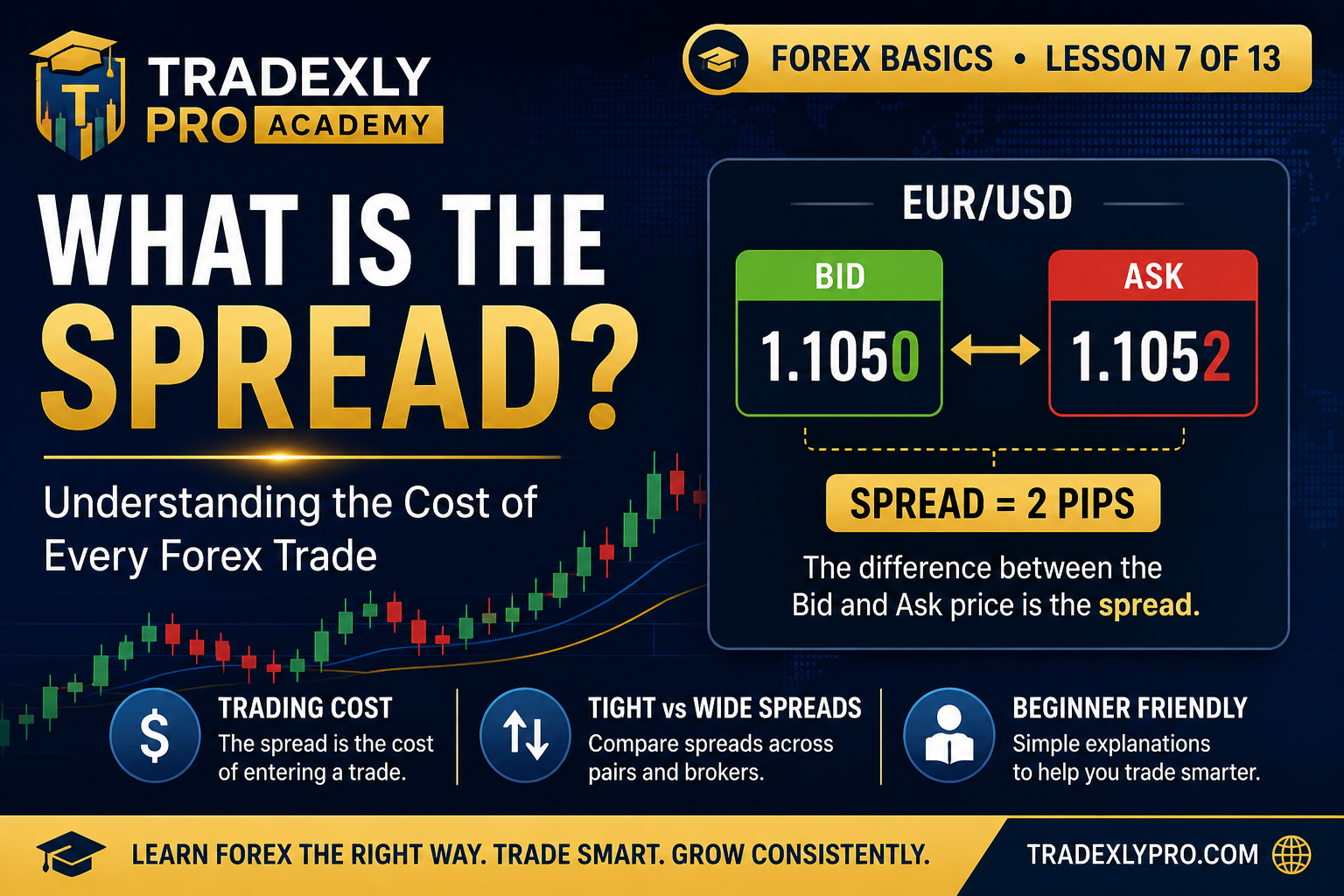
The spread is the difference between the Bid Price and the Ask Price of a currency pair. Think back to the previous lesson. You learned that:
- The Bid Price is the price at which you sell.
- The Ask Price is the price at which you buy.
Because these two prices are never exactly the same, there is always a small gap between them. That gap is known as the spread. The spread is usually measured in pips, which is why understanding Lesson 5 and Lesson 6 is essential before learning this topic.
Example
| Bid Price | Ask Price | Spread |
|---|---|---|
| 1.1050 | 1.1052 | 2 Pips |
In this example, the difference between the Bid Price and the Ask Price is 2 pips. That difference represents the spread.
Why Does the Spread Exist?
Many beginners think the spread is simply a fee charged by the broker. While brokers often earn revenue through the spread, its existence is rooted in how financial markets function. Every market has buyers who want to pay the lowest possible price and sellers who want to receive the highest possible price. The spread represents the small gap between those two prices. In the Forex market, brokers connect buyers and sellers while providing liquidity and executing trades. The spread helps cover the cost of providing that service and, depending on the broker’s pricing model, may also form part of the broker’s compensation.
Professional Insight
Professional traders pay close attention to spreads because they directly affect trading costs. A strategy that performs well with a one-pip spread may become less profitable if the spread regularly widens to three or four pips. This is one reason experienced traders compare brokers carefully before opening an account.
How to Calculate the Spread
Calculating the spread is much easier than most beginners expect. Simply subtract the Bid Price from the Ask Price. The difference between these two prices is the spread.
Example 1
| Bid Price | Ask Price | Spread |
|---|---|---|
| 1.1050 | 1.1052 | 2 Pips |
The Ask Price is two pips higher than the Bid Price, so the spread is 2 pips.
Example 2
| Bid Price | Ask Price | Spread |
|---|---|---|
| 1.2845 | 1.2848 | 3 Pips |
Here, the difference is 3 pips. Every time you open a trade, this spread represents the initial trading cost.
Quick Rule
Spread = Ask Price − Bid Price
If the Ask Price is 1.1052 and the Bid Price is 1.1050, the spread is 2 pips. Once you understand this simple calculation, you’ll be able to compare trading costs across different brokers and currency pairs.
Tight Spreads vs Wide Spreads
Not all spreads are the same. Some currency pairs have extremely small spreads, while others have much larger ones. Generally speaking:
- Tight spreads mean lower trading costs.
- Wide spreads mean higher trading costs.
Professional traders usually prefer tighter spreads because less price movement is needed before a trade becomes profitable. However, spreads are only one factor when choosing a broker. Reliability, regulation, execution speed, and customer support are equally important.
| Tight Spread | Wide Spread |
|---|---|
| Lower trading cost | Higher trading cost |
| Often found on major pairs | More common on exotic pairs |
| Better for frequent trading | Can reduce profitability |
| Usually available during active market sessions | Often seen during quiet or volatile markets |
Did You Know?
Major currency pairs such as EUR/USD, GBP/USD, and USD/JPY usually have the lowest spreads because they are traded in very high volumes every day. Exotic currency pairs often have wider spreads due to lower market liquidity.
Why Do Spreads Change?
One of the biggest surprises for new traders is discovering that spreads are not always fixed. Depending on your broker and account type, spreads can widen or narrow throughout the trading day. This happens because market conditions are constantly changing. When there are many buyers and sellers actively trading, spreads are usually very small. When trading activity slows down or uncertainty increases, spreads often become wider.
Situations That Can Cause Wider Spreads
- Major economic news announcements.
- Low-liquidity trading sessions.
- Market opening and closing times.
- Periods of high market volatility.
- Unexpected geopolitical events.
For example, if an important interest rate decision is about to be announced, brokers may temporarily increase spreads because prices can move extremely quickly. This protects both liquidity providers and market participants from sudden price fluctuations.
Important
Many beginners believe their broker is manipulating prices when spreads widen during major news events. In reality, wider spreads during volatile market conditions are common across the Forex industry and often reflect reduced liquidity and increased uncertainty.
Professional Insight
Experienced traders always check the current spread before entering a trade. Even a strong trading setup can become less attractive if spreads suddenly widen. Monitoring spreads is part of good trade planning and helps traders avoid unnecessary costs.
Real Trading Examples
Let’s look at how the spread affects real trades. Understanding these examples will help you see why experienced traders always consider trading costs before entering the market.
Example 1: A Trade with a Tight Spread
EUR/USD is quoted as:
| Bid | Ask | Spread |
|---|---|---|
| 1.1050 | 1.1051 | 1 Pip |
You decide to buy EUR/USD at 1.1051. Immediately after opening the trade, the Bid Price remains at 1.1050. Your position starts with a small unrealized loss of 1 pip. If the market rises by just one additional pip, you’ve already recovered the spread and reached your entry price.
Example 2: A Trade with a Wide Spread
Now consider another currency pair.
| Bid | Ask | Spread |
|---|---|---|
| 145.20 | 145.28 | 8 Pips |
This time, your trade begins with an 8-pip disadvantage. Before you can make any profit, the market must first move enough to recover those eight pips. This illustrates why traders generally prefer lower spreads whenever possible.
Does Every Currency Pair Have the Same Spread?
No. Every currency pair has its own typical spread, which can change depending on market conditions. Generally speaking:
| Currency Pair Type | Typical Spread | Reason |
|---|---|---|
| Major Pairs | Usually the lowest | High trading volume and strong liquidity. |
| Minor Pairs | Moderate | Lower trading activity than major pairs. |
| Exotic Pairs | Usually the highest | Lower liquidity and higher market risk. |
This is another reason why beginners often start by trading major currency pairs such as EUR/USD. They typically offer lower trading costs and smoother price movement compared to many exotic pairs.
Beginner Recommendation
If you’re just starting your Forex journey, focus on highly liquid major currency pairs. They usually provide tighter spreads, better execution, and a more stable trading environment while you’re learning.
Common Beginner Mistakes
1. Ignoring the Spread
Many beginners only look at whether the market is moving up or down. Professional traders also consider the spread because it directly affects trading costs.
2. Trading During High-Impact News Without Understanding Spreads
Major news events can cause spreads to widen significantly. Entering trades without checking the spread may result in unexpectedly high trading costs.
3. Choosing a Broker Based Only on Advertising
A broker promising bonuses or promotions isn’t necessarily the best choice. Professional traders compare spreads, regulation, execution quality, and overall reliability before opening an account.
4. Confusing Spread with Commission
Although both are trading costs, they are not the same. Some brokers charge only a spread, while others charge a very small spread plus a separate commission. Always understand your broker’s pricing model before you begin trading.
Lesson Summary
- The spread is the difference between the Bid Price and the Ask Price.
- It represents one of the primary costs of trading Forex.
- Tighter spreads generally mean lower trading costs.
- Major currency pairs usually have lower spreads than exotic pairs.
- Spreads can widen during periods of low liquidity or high market volatility.
- Understanding spreads will help you make smarter trading decisions and compare brokers more effectively.
Practice Exercise
Open your trading platform and compare the spreads on these three currency pairs:
- EUR/USD
- GBP/USD
- USD/TRY (or another exotic pair available on your platform)
Write down the spread for each pair. Ask yourself:
- Which pair has the smallest spread?
- Which pair has the largest spread?
- Why do you think there is such a difference?
By observing real market prices, you’ll quickly develop an understanding of how spreads vary across different currency pairs and market conditions.
Looking Ahead
Now that you understand the cost of entering a trade, the next step is learning how trade sizes are measured. In the next lesson, you’ll discover what a lot is, why position size matters, and how professional traders calculate the size of every trade before risking any money. Understanding lots is essential before moving on to leverage, margin, and risk management.
Frequently Asked Questions (FAQs)
What is the spread in Forex?
The spread is the difference between the Bid Price and the Ask Price of a currency pair. It represents one of the main costs of opening a Forex trade.
Why do Forex brokers charge a spread?
The spread helps facilitate trading by reflecting the difference between buying and selling prices. Depending on the broker’s pricing model, it may also contribute to the broker’s compensation for providing market access, liquidity, and trade execution.
Is a lower spread always better?
In most cases, yes. Lower spreads reduce trading costs, meaning the market doesn’t have to move as far before your trade reaches profitability. However, spreads should be considered alongside factors such as broker regulation, execution speed, reliability, and commissions.
Why do spreads become wider?
Spreads often widen during periods of high market volatility, major economic news releases, holidays, and low-liquidity trading sessions. These changes are a normal part of financial markets and are not unique to any single broker.
Can I see the spread before opening a trade?
Yes. Most trading platforms display both the Bid Price and Ask Price in real time. The difference between these two prices is the spread, allowing you to evaluate the trading cost before entering the market.
Ready to Continue Your Forex Journey?
You’ve now mastered another essential Forex concept. Understanding spreads will help you compare brokers, estimate trading costs, and make more informed trading decisions. If you’re serious about learning Forex step by step, join the Tradexly Pro Starter Program and continue building your trading knowledge with structured lessons, beginner-friendly resources, and trusted broker recommendations.