How It Works, Why Brokers Offer It & The Risks Every Beginner Must Know
What Is Leverage in Forex? How It Works and Why It Can Be Risky
One of the biggest reasons Forex trading is so popular is leverage. It allows traders to control positions much larger than the money they actually have. While leverage can increase potential profits, it can also magnify losses. Understanding how leverage works is essential before placing your first live trade.
Learning Outcomes
- Understand what leverage means in Forex.
- Learn why brokers offer leverage.
- Understand how leverage affects your buying power.
- Discover the advantages and disadvantages of using leverage.
- Learn why leverage itself is not dangerous—misusing it is.
- Prepare for the next lesson on Margin.
Table of Contents
- What Is Leverage?
- Why Do Brokers Offer Leverage?
- How Leverage Works
- Common Leverage Ratios
- Real Trading Examples
- Advantages of Leverage
- Risks of Leverage
- Leverage vs Position Size
- Common Beginner Mistakes
- FAQs
- What’s Next?
Imagine Buying a House…
Imagine you want to buy a house worth $300,000. Very few people pay the full amount in cash. Instead, they make a small deposit while the bank provides the remaining funds through a mortgage. The buyer controls a much larger asset than the cash they personally contributed. Forex leverage works in a very similar way. Instead of borrowing money to buy a house, your broker temporarily allows you to control a much larger trading position using a relatively small amount of your own capital.
Did You Know?
Without leverage, the Forex market would require significantly larger amounts of money to trade. Leverage makes the market accessible to retail traders with smaller account balances.
What Is Leverage?
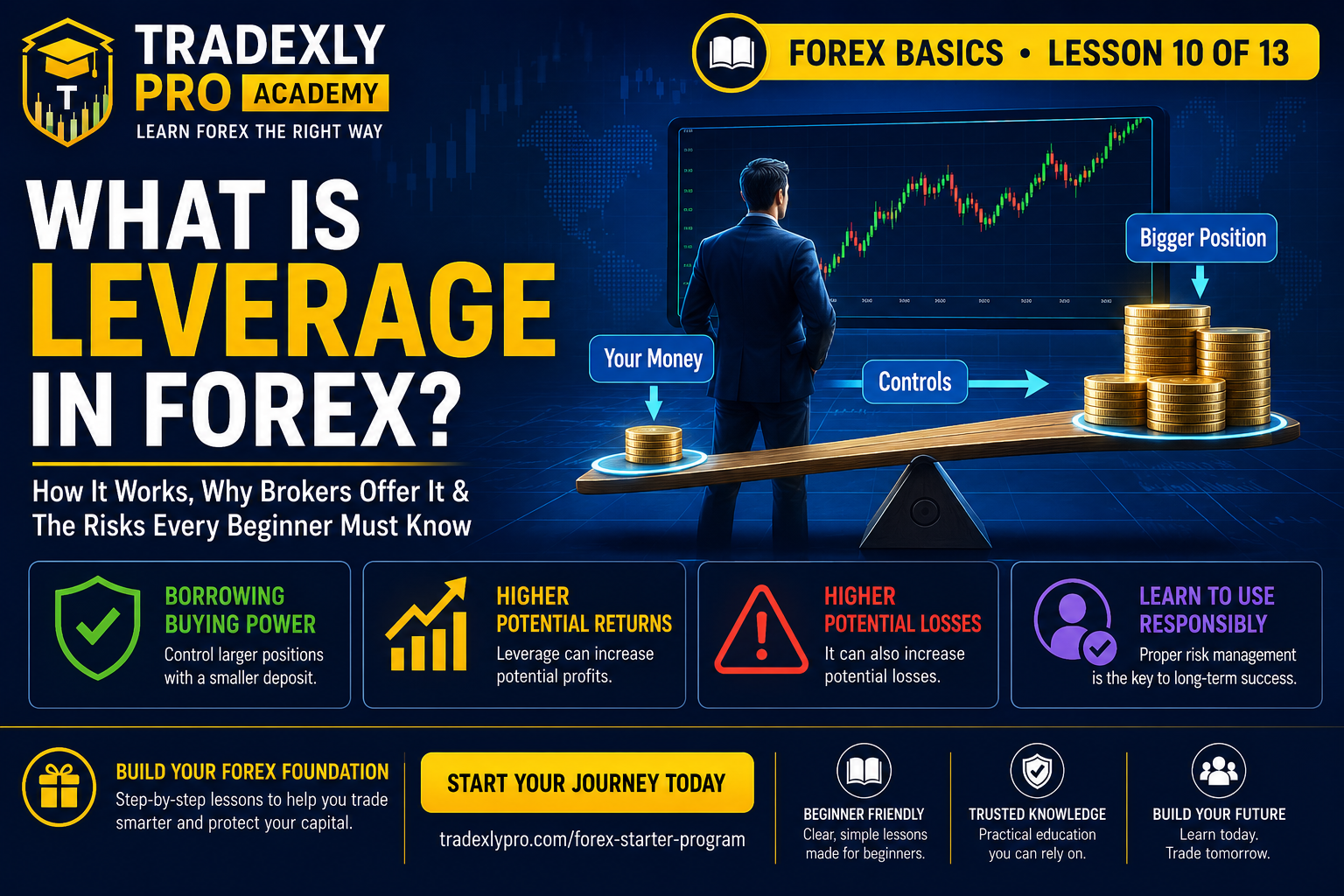
Leverage is a tool provided by your broker that allows you to control a larger trading position using a smaller amount of your own money. It increases your buying power without requiring you to deposit the full value of the trade.
For example, instead of needing $10,000 to open a position, leverage may allow you to open the same position using only a few hundred dollars as collateral.
Simple Definition
Leverage is borrowed buying power provided by your broker. It allows a relatively small deposit to control a much larger position in the Forex market.
Why Do Forex Brokers Offer Leverage?
Brokers provide leverage because it makes Forex trading more accessible. If traders were required to pay the full value of every trade, many people wouldn’t have enough capital to participate. By allowing traders to control larger positions with smaller deposits, brokers increase market participation while still requiring traders to maintain sufficient collateral through margin requirements.
Leverage benefits both traders and brokers by increasing trading activity, but it must always be used responsibly.
How Does Leverage Actually Work?
At first glance, leverage can seem like free money. Many beginners believe their broker is simply giving them extra cash to trade with. That isn’t actually what’s happening.
Leverage doesn’t put extra money into your bank account. Instead, it increases the size of the position you are allowed to control while only requiring you to provide a small portion of the total trade value. Your deposit acts as security, often called margin, while the broker temporarily provides the additional buying power needed to open the trade.
A Simple Analogy
Imagine you’re moving a heavy object. Without any tools, you must lift the full weight yourself. Now imagine using a long lever. The object hasn’t become lighter, but the lever allows you to move something much heavier using much less force. Forex leverage works in a similar way. Your trading capital doesn’t increase, but leverage allows that capital to control a much larger market position.
Key Point
Leverage increases your buying power. It does not increase the amount of money you own.
Understanding Leverage Ratios
Leverage is usually displayed as a ratio. Examples include:
| Leverage | You Control |
|---|---|
| 1:10 | $10 for every $1 you provide. |
| 1:30 | $30 for every $1 you provide. |
| 1:50 | $50 for every $1 you provide. |
| 1:100 | $100 for every $1 you provide. |
| 1:200 | $200 for every $1 you provide. |
| 1:500 | $500 for every $1 you provide. |
The larger the leverage ratio, the greater the buying power available to the trader. However, greater buying power also means market movements have a much larger impact on your trading account.
Important
Higher leverage does not increase the probability of making profitable trades. It only increases how quickly profits—or losses—can accumulate.
Real Example of 1:100 Leverage
Imagine your trading account contains $1,000. Without leverage, you could only open positions worth approximately $1,000.
Now suppose your broker offers 1:100 leverage. Instead of controlling only $1,000, you could potentially control positions worth up to:
$1,000 × 100 = $100,000
This doesn’t mean you’ve been given $99,000. It simply means your broker allows your $1,000 deposit to control a position with a total value of up to $100,000.
Did You Know?
Even if you have access to high leverage, you are never required to use all of it. Professional traders often use only a small fraction of the leverage available to them.
Does Higher Leverage Mean Higher Profits?
Not necessarily. Higher leverage increases both potential profits and potential losses. If the market moves in your favour, profits can grow more quickly. If the market moves against you, losses grow just as quickly.
This is why experienced traders don’t judge a broker by its maximum leverage. Instead, they focus on using leverage responsibly as part of a disciplined risk management plan.
Example
Trader A uses moderate leverage with proper position sizing and risks only 1% of the account. Trader B uses the maximum leverage available and risks half the account on one trade. Even if both traders have the same market analysis, Trader A is far more likely to survive long enough to become consistently profitable.
Why High Leverage Can Be Dangerous
One of the biggest misconceptions in Forex is believing that higher leverage automatically creates higher income. In reality, high leverage simply increases exposure to market movements. Small price changes can produce large gains—but they can also produce equally large losses.
Many beginners lose money not because leverage exists, but because they misuse it by opening positions that are far too large for their account size.
Professional Insight
Leverage is like a powerful sports car. In the hands of an experienced driver, it can be used effectively. In the hands of someone with little experience, it can become dangerous very quickly. The tool itself isn’t the problem—how it’s used is what matters.
Advantages of Using Leverage
When used responsibly, leverage offers several important benefits. This is one of the reasons Forex has become one of the world’s largest financial markets. However, these advantages only exist when leverage is combined with proper risk management.
1. Greater Buying Power
Leverage allows traders with relatively small accounts to participate in markets that would otherwise require a much larger investment. For example, instead of needing tens of thousands of dollars to trade major currency pairs, leverage allows traders to control similar positions with a much smaller deposit.
2. Better Use of Trading Capital
Without leverage, a large portion of your trading capital would be tied up in a single position. Leverage allows you to use only a fraction of your account to open a trade, leaving the remaining funds available for other opportunities or as a safety buffer.
3. Access to More Trading Opportunities
Because less capital is required for each position, traders can diversify their trades rather than committing all of their funds to a single currency pair. Diversification can help reduce overall portfolio risk when managed correctly.
Professional Perspective
Professional traders don’t use leverage because they want to gamble. They use it as a financial tool that allows them to allocate capital more efficiently while still maintaining strict risk controls.
The Risks of Leverage
While leverage can increase buying power, it also magnifies losses. This is why many beginners lose money shortly after opening a live trading account. The problem isn’t leverage itself—it is using too much of it without a proper risk management plan.
Risk 1: Losses Increase Faster
If leverage allows profits to grow faster, it also allows losses to grow at exactly the same rate. A small market movement against your position can produce a significant financial loss when trading oversized positions.
Risk 2: Emotional Trading
Large positions often create emotional pressure. Traders may panic during small market movements, close profitable trades too early, or refuse to accept losses because too much money is at stake.
Risk 3: Account Blow-Up
One of the fastest ways to destroy a trading account is by combining high leverage with poor position sizing. A few losing trades using excessive leverage can wipe out months—or even years—of progress.
Risk 4: False Confidence
Many beginners see large profits from their first few trades and assume they have mastered the market. In reality, those profits may simply be the result of excessive leverage. Eventually, one losing trade can erase all previous gains if proper risk management is ignored.
Leverage vs Position Size
One of the biggest misconceptions among beginners is believing that leverage determines how much money they should risk. It doesn’t.
Your position size should always be determined by your account balance, your acceptable risk percentage, and your stop-loss distance—not by the maximum leverage your broker offers.
Example
Imagine your broker offers leverage of 1:500. That doesn’t mean every trade should use the maximum buying power available. A professional trader may have access to 1:500 leverage and still choose a small position because their trading plan only allows a 1% risk on that setup.
Remember This
Leverage determines what you can control. Position sizing determines what you should control. Successful traders always let risk management make that decision.
Common Beginner Mistakes
1. Using Maximum Leverage on Every Trade
Just because your broker offers high leverage doesn’t mean you should use it. Professional traders rarely use the maximum leverage available.
2. Confusing Leverage with Free Money
Leverage is borrowed buying power. It doesn’t increase your account balance, and it certainly doesn’t eliminate trading risk.
3. Ignoring Risk Management
Many beginners focus on increasing profits while forgetting to calculate position size and stop-loss levels. Without risk management, leverage becomes far more dangerous.
4. Chasing Quick Riches
Some traders believe using the highest leverage available will help them become profitable faster. In reality, excessive leverage usually shortens a trader’s lifespan in the market rather than accelerating long-term success.
Lesson Summary
- Leverage increases your buying power by allowing you to control larger positions with a smaller deposit.
- Higher leverage increases both potential profits and potential losses.
- Leverage is a tool—not a strategy.
- Responsible traders combine leverage with proper position sizing and disciplined risk management.
- Having access to high leverage doesn’t mean you should use all of it.
- Long-term success comes from protecting capital first and pursuing profits second.
Practice Exercise
Let’s test what you’ve learned. Imagine you have the following trading account:
- Account Balance: $2,500
- Broker Leverage: 1:100
- Maximum Risk Per Trade: 1%
Answer the following questions before using a calculator.
- How much money are you willing to risk on one trade?
- Does having 1:100 leverage mean you should always use it?
- If your broker increases your leverage to 1:500, should your risk management plan change?
- Why is position size more important than leverage?
- Can high leverage make a bad trading strategy profitable?
Challenge Yourself
Try answering these questions without looking back through the lesson. If you can explain leverage in your own words, you’ve understood one of the most important concepts in Forex trading.
Frequently Asked Questions
What is leverage in Forex?
Leverage is a facility provided by a broker that allows traders to control a larger trading position using a smaller amount of their own capital. It increases buying power but also increases exposure to market movements.
Is higher leverage always better?
No. Higher leverage simply gives you access to larger positions. It does not improve your trading strategy or increase your chances of making profitable trades. Without proper risk management, higher leverage can lead to larger losses.
Can I choose my leverage?
In many cases, yes. Some brokers allow traders to select different leverage levels, while others are restricted by financial regulations depending on the country or region.
Is leverage the same as margin?
No. Leverage and margin are closely related but they are not the same thing. Leverage increases your buying power, while margin is the amount of money required to open and maintain a leveraged position. The next lesson explains margin in detail.
Do professional traders use leverage?
Yes. Professional traders often use leverage, but they usually combine it with strict position sizing and disciplined risk management. Their goal is not to maximise leverage but to manage risk effectively.
Can leverage cause me to lose more money than I deposited?
This depends on your broker, market conditions, and whether your account has negative balance protection. Many regulated brokers provide negative balance protection for retail clients, but it’s important to check your broker’s specific policies.
Trade Smarter, Not Bigger
Leverage can be one of the most useful tools available to a Forex trader—but only when used responsibly. The traders who survive for years aren’t the ones using the highest leverage. They’re the ones who consistently manage risk and protect their capital. Continue learning through the Tradexly Pro Academy and build the knowledge needed to trade with confidence.