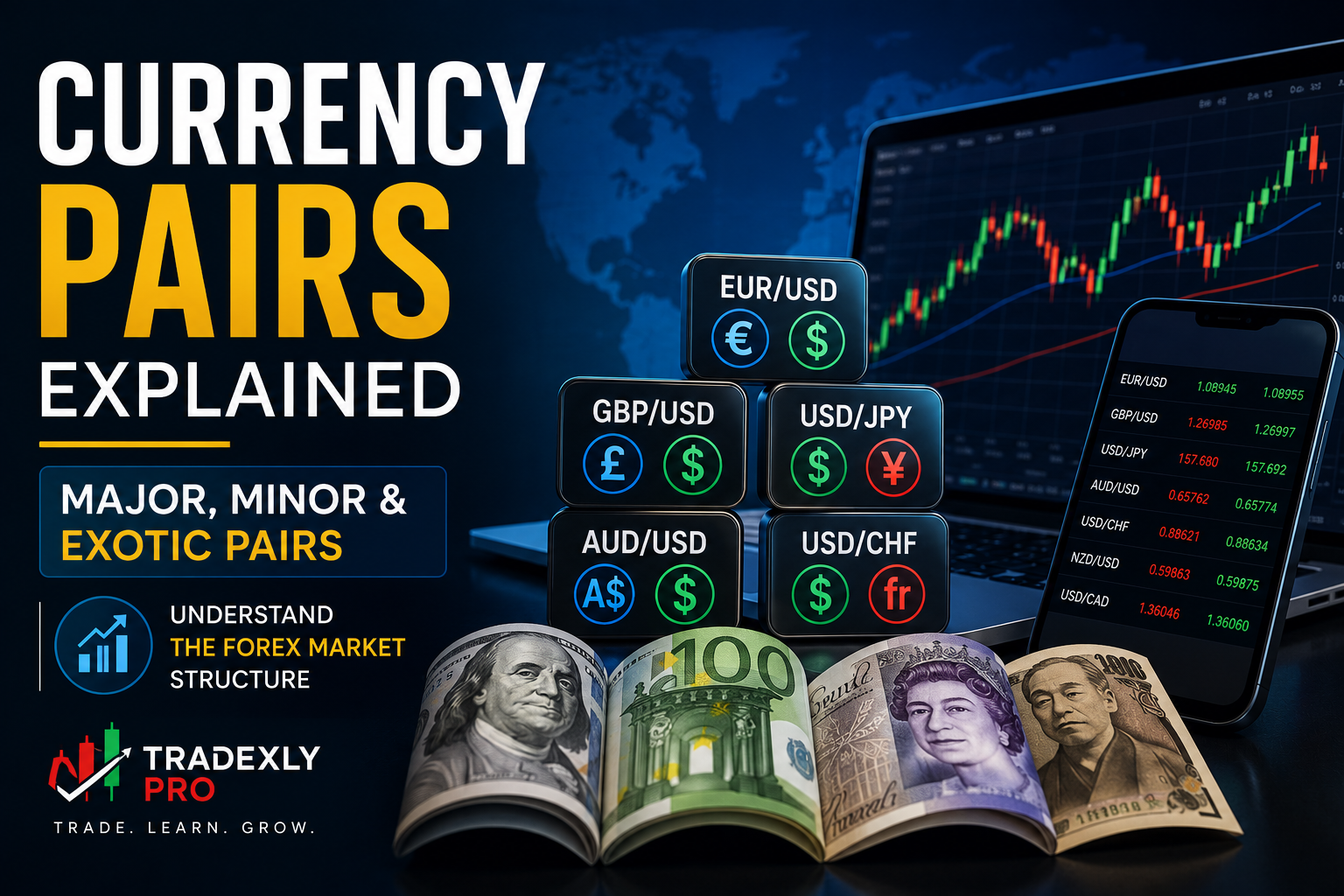
Currency Pairs Explained: Major, Minor & Exotic Pairs
If you’ve ever opened a trading platform, you’ve probably seen symbols such as EUR/USD, GBP/USD, USD/JPY, or AUD/USD. At first glance they may seem confusing, but they represent the foundation of every forex trade.
Unlike the stock market, where investors buy and sell shares of individual companies, the forex market always involves two currencies. Whenever you place a trade, you are buying one currency while simultaneously selling another. This relationship is known as a currency pair.
Understanding currency pairs is one of the first and most important skills every trader should master. Before learning trading strategies, technical analysis, or risk management, you must first understand exactly what you are trading.
In this complete beginner’s guide, you’ll learn how currency pairs work, the difference between major, minor, and exotic pairs, how exchange rates move, and which currency pairs beginners should focus on first.
Table of Contents
What Is a Currency Pair?
A currency pair is the quotation of one currency against another. It shows how much of one currency is needed to buy one unit of another currency.
Every forex trade involves two currencies because you are always buying one currency while selling another at the same time.
If you buy EUR/USD, you are buying Euros while selling US Dollars.
If you sell EUR/USD, you are selling Euros while buying US Dollars.
Think of every forex trade as an exchange. You cannot buy one currency without selling another.
Major Currency Pairs
Major currency pairs are the most actively traded currencies in the forex market. Every major pair includes the US Dollar (USD), which is the world’s primary reserve currency and the most traded currency globally.
Because these pairs are traded by millions of market participants every day, they usually offer the highest liquidity, the lowest spreads, and the most stable trading conditions.
For beginners, major pairs are often the best place to start because they are easier to trade and generally experience smoother price movements than exotic pairs.
| Currency Pair | Name | Popularity |
|---|---|---|
| EUR/USD | Euro / US Dollar | ★★★★★ |
| GBP/USD | British Pound / US Dollar | ★★★★★ |
| USD/JPY | US Dollar / Japanese Yen | ★★★★★ |
| USD/CHF | US Dollar / Swiss Franc | ★★★★☆ |
| AUD/USD | Australian Dollar / US Dollar | ★★★★☆ |
| USD/CAD | US Dollar / Canadian Dollar | ★★★★☆ |
| NZD/USD | New Zealand Dollar / US Dollar | ★★★★☆ |
If you’re opening your first demo account, focus on only one or two major currency pairs, such as EUR/USD and GBP/USD. Learning how these pairs move is far more valuable than trying to trade ten different pairs at once.
EUR/USD is the most traded currency pair in the world, accounting for a significant share of daily forex trading volume. Its high liquidity often results in tighter spreads, making it a popular choice for both beginners and professional traders.
Minor Currency Pairs
Minor currency pairs, also known as cross-currency pairs, are currency pairs that do not include the US Dollar. Instead, they combine two other major global currencies.
Although they are traded less frequently than major pairs, minor pairs still have strong liquidity and are popular among experienced traders looking for additional opportunities.
Because the US Dollar is not involved, these pairs often behave differently from major pairs and may react more strongly to economic news from their respective countries.
| Currency Pair | Name | Common Nickname |
|---|---|---|
| EUR/GBP | Euro / British Pound | Euro Pound |
| EUR/JPY | Euro / Japanese Yen | Euro Yen |
| GBP/JPY | British Pound / Japanese Yen | The Dragon |
| EUR/CHF | Euro / Swiss Franc | Euro Swiss |
| AUD/JPY | Australian Dollar / Japanese Yen | Aussie Yen |
| GBP/CHF | British Pound / Swiss Franc | Pound Swiss |
Although minor pairs can offer excellent trading opportunities, beginners should first become comfortable trading major pairs before expanding into cross-currency pairs.
Exotic Currency Pairs
Exotic currency pairs consist of one major currency and one currency from an emerging or developing economy.
These pairs are usually less liquid than majors and minors, meaning fewer buyers and sellers are trading them at any given time. As a result, they often experience wider spreads, greater volatility, and sharper price swings.
While exotic pairs can produce significant price movements, they also carry higher risk and generally require more trading experience.
| Currency Pair | Country |
|---|---|
| USD/TRY | Turkey |
| USD/ZAR | South Africa |
| USD/MXN | Mexico |
| USD/THB | Thailand |
| EUR/TRY | Euro / Turkish Lira |
Exotic pairs can experience sudden and unpredictable price movements caused by political events, economic instability, or lower market liquidity. These conditions can increase trading costs and risk.
For this reason, most beginner traders are advised to avoid exotic pairs until they have gained more experience managing risk and understanding market behavior.
- Major Pairs — Highest liquidity, lowest spreads, best choice for beginners.
- Minor Pairs — Good liquidity, no US Dollar, suitable after gaining experience.
- Exotic Pairs — Higher volatility, wider spreads, higher risk, generally recommended for experienced traders.
Which Currency Pairs Should Beginners Trade?
If you’re just starting your forex journey, choosing the right currency pairs can make a significant difference in your learning experience. While there are dozens of currency pairs available, beginners do not need to trade all of them.
The best approach is to focus on highly liquid currency pairs with lower spreads, consistent price movements, and plenty of educational resources available online.
| Currency Pair | Why It’s Good for Beginners |
|---|---|
| EUR/USD | Highest liquidity, tight spreads, abundant learning resources. |
| GBP/USD | Strong daily movements with excellent liquidity. |
| USD/JPY | Stable price action and highly traded worldwide. |
| AUD/USD | Often follows clear market trends and is beginner-friendly. |
| USD/CAD | Frequently influenced by oil prices, making it educational to study. |
Master one or two currency pairs before adding more to your watchlist. Professional traders often specialize instead of trying to trade every available market.
Common Mistakes Beginners Make
Learning about currency pairs is only the first step. Many beginners make avoidable mistakes that slow their progress and increase their trading risk.
- Trading too many currency pairs at the same time.
- Choosing exotic pairs because they appear to move more.
- Ignoring the economic news affecting each currency.
- Not understanding which currency is the base and which is the quote.
- Switching between different pairs without developing consistency.
Successful traders usually become familiar with a small number of currency pairs before expanding into additional markets. This allows them to understand each pair’s behavior, volatility, and reaction to economic news.
Many professional forex traders spend years focusing primarily on just a handful of major currency pairs. Deep knowledge of a few markets is often more valuable than shallow knowledge of many.
Key Takeaways
- A currency pair always consists of two currencies.
- The first currency is called the Base Currency.
- The second currency is called the Quote Currency.
- Major pairs include the US Dollar and offer the highest liquidity.
- Minor pairs do not include the US Dollar.
- Exotic pairs combine a major currency with a currency from an emerging economy and generally carry higher risk.
- Beginners should concentrate on major currency pairs while building their skills.
Frequently Asked Questions (FAQs)
Can I trade only one currency in forex?
No. Forex trading always involves two currencies because you are exchanging one currency for another. Every trade is made using a currency pair.
Which currency pair is the easiest for beginners?
Most beginners start with EUR/USD because it has high liquidity, relatively low spreads, and plenty of educational material available. Other beginner-friendly pairs include GBP/USD, USD/JPY, and AUD/USD.
Why are major currency pairs more popular?
Major pairs are traded by millions of participants worldwide, resulting in higher liquidity, faster execution, and lower trading costs. They also tend to have more predictable price movements than many exotic pairs.
Should beginners trade exotic currency pairs?
Generally, no. Exotic pairs often have wider spreads, lower liquidity, and higher volatility. Beginners are usually better served by learning with major currency pairs before exploring more complex markets.
How many currency pairs should I trade?
There is no fixed number, but most successful beginners focus on one or two major pairs until they understand how they move. Expanding your watchlist can come later as your experience grows.
🎁 Get Your FREE Tradexly Pro Starter Kit
Take the next step in your forex journey with our free beginner resource designed to help you build a strong trading foundation.
- ✔ Beginner Forex Roadmap
- ✔ Essential Trading Terminology
- ✔ Risk Management Basics
- ✔ Professional Trading Resources
- ✔ Exclusive Educational Content
Final Thoughts
Understanding currency pairs is one of the most important building blocks in forex trading. Every chart, every trade, and every market movement revolves around the relationship between two currencies.
As a beginner, your goal should not be to trade every available pair. Instead, focus on learning how a small number of major currency pairs behave, why they move, and how economic events influence their prices. Building deep knowledge of a few markets is far more valuable than having shallow knowledge of many.
As you continue through the Tradexly Pro Forex Basics series, you’ll build on this foundation by learning about pips, lot sizes, leverage, margin, risk management, and the practical skills needed to trade with confidence.