What Is a Market Order?
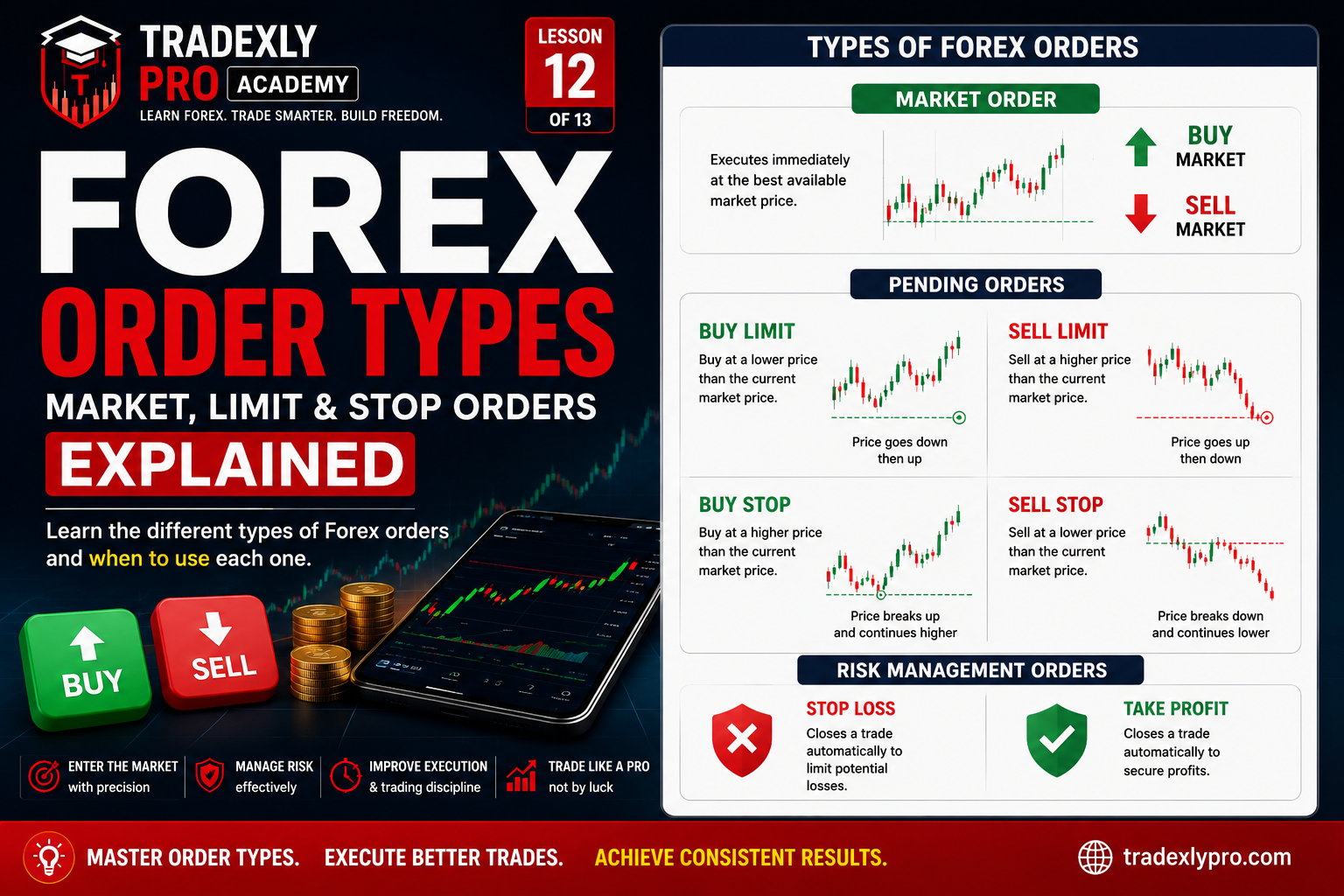
A Market Order is an instruction to buy or sell a currency pair immediately at the best available price. It is the fastest and most direct way to enter or exit the Forex market. When you place a Market Order, you are telling your broker:
“Execute this trade now at the best price currently available.”
Market Orders are commonly used when a trader believes that entering the market immediately is more important than waiting for a specific price. They are especially useful during active market conditions when prices are moving quickly and the trader does not want to miss a potential opportunity.
Market Buy Example
Suppose EUR/USD is currently trading around 1.1050. You believe the price is about to rise. Instead of waiting for a lower price, you place a Market Buy Order. Your broker immediately opens a buy position at the best available asking price.
Market Sell Example
Suppose GBP/USD is trading around 1.2800. You believe the price is about to fall. You place a Market Sell Order, and your broker immediately opens a sell position at the best available bid price.
Advantages of Market Orders
- They are executed quickly.
- They are easy for beginners to understand.
- They allow traders to enter fast-moving markets immediately.
- They are useful when the exact entry price is less important than getting into the trade.
Disadvantages of Market Orders
- The final execution price may differ slightly from the price shown on your screen.
- They may be affected by slippage during volatile market conditions.
- They can encourage emotional or impulsive trading.
- They may lead to poor entries if the trader enters after a large price movement has already occurred.
Important
A Market Order guarantees that your order will be executed as quickly as possible, but it does not guarantee the exact price at which the trade will open. The price may change between the moment you click the button and the moment your broker completes the order.
What Is Slippage?
Slippage is the difference between the price you expected to receive and the actual price at which your trade was executed. It can happen because Forex prices are constantly changing. During normal market conditions, slippage may be very small or may not happen at all. However, during major economic announcements, market openings, or periods of low liquidity, prices can move rapidly.
Slippage Example
Imagine you place a Market Buy Order on EUR/USD when the price displayed on your screen is 1.1050. By the time the broker processes your order, the best available price has moved to 1.1053. Your trade is therefore opened three pips higher than expected. That three-pip difference is slippage.
Positive and Negative Slippage
Slippage is not always negative. Sometimes your order may be executed at a better price than expected.
- Negative slippage: You receive a worse price than expected.
- Positive slippage: You receive a better price than expected.
What Is a Pending Order?
A Pending Order is an instruction to buy or sell a currency pair only when the market reaches a specific price chosen by the trader. Unlike a Market Order, a Pending Order does not execute immediately. It remains inactive on the trading platform until the required price level is reached.
Pending Orders are useful because they allow traders to plan their entries in advance. Instead of watching the market continuously, a trader can identify an important price level, place an order, and allow the trading platform to execute the trade automatically if the market reaches that level.
Simple Example
Suppose EUR/USD is currently trading at 1.1050, but you only want to buy if the price falls to 1.1000. You can place a Pending Order at 1.1000. If the price falls to that level, the broker will automatically open the trade. If the market never reaches 1.1000, the trade will not be opened.
Why Traders Use Pending Orders
- To enter trades at more favourable prices.
- To trade breakouts automatically.
- To avoid entering the market emotionally.
- To follow a trading plan even when they are away from the screen.
- To avoid chasing prices after a large market move.
Did You Know?
Many experienced traders prefer Pending Orders because they allow the trader to make decisions calmly before the market reaches the entry level. This can reduce impulsive trading and improve discipline.
The Four Main Pending Orders
There are four main Pending Orders used in Forex trading. They are:
- Buy Limit
- Sell Limit
- Buy Stop
- Sell Stop
These names may appear confusing at first, but they become much easier to understand when you focus on two simple questions:
- Do you want to buy or sell?
- Do you expect the price to reverse or continue moving?
| Order | Placed Where? | Main Expectation |
|---|---|---|
| Buy Limit | Below the current market price | Price will fall first, then rise. |
| Sell Limit | Above the current market price | Price will rise first, then fall. |
| Buy Stop | Above the current market price | Price will break higher and continue rising. |
| Sell Stop | Below the current market price | Price will break lower and continue falling. |
The Easiest Way to Remember Them
Limit Orders are generally used when you expect a reversal.
Stop Orders are generally used when you expect continuation after a breakout.
What Is a Buy Limit Order?
A Buy Limit Order is an instruction to buy a currency pair at a price below the current market price. The trader expects the market to fall first, reach a lower price, and then reverse upward.
This order type is commonly used when a trader believes the current market price is too expensive and wants to wait for a better buying opportunity.
Buy Limit Example
Suppose EUR/USD is currently trading at 1.1050. You believe the market may temporarily fall to 1.1000 before rising again. Instead of buying immediately at 1.1050, you place a Buy Limit Order at 1.1000.
If the price falls to 1.1000, your Buy Limit Order is activated and a buy trade is opened. If the price does not reach 1.1000, the order remains pending.
How to Think About a Buy Limit
A Buy Limit is similar to waiting for a discount. You want to buy, but only at a lower and more attractive price.
When Traders Use Buy Limit Orders
- When buying near a support level.
- When expecting a temporary pullback during an uptrend.
- When waiting for a better entry price.
- When the current price appears overextended.
Risk of a Buy Limit Order
The market may fall to your entry price and continue falling instead of reversing upward. A Buy Limit Order does not guarantee that the market will bounce. This is why traders should normally place a Stop Loss below the level that would invalidate their trade idea.
What Is a Sell Limit Order?
A Sell Limit Order is an instruction to sell a currency pair at a price above the current market price. The trader expects the market to rise first, reach a higher level, and then reverse downward.
This order type is commonly used when a trader believes the current market price is too low and wants to wait for a better selling opportunity.
Sell Limit Example
Suppose GBP/USD is currently trading at 1.2800. You believe the market may rise to 1.2850 before turning lower. You place a Sell Limit Order at 1.2850.
If the market rises to 1.2850, the order is activated and a sell trade is opened. If the price never reaches 1.2850, the order remains pending and no trade is opened.
How to Think About a Sell Limit
A Sell Limit allows you to wait for a higher selling price. Instead of selling immediately, you wait for the market to move upward into an area where you expect sellers to take control.
When Traders Use Sell Limit Orders
- When selling near a resistance level.
- When expecting a temporary rally during a downtrend.
- When waiting for a more favourable selling price.
- When the market appears overbought or overextended.
Risk of a Sell Limit Order
The market may rise to your entry price and continue moving higher instead of reversing downward. A Sell Limit Order should therefore be supported by a clear trading plan and an appropriate Stop Loss.
Buy Limit vs Sell Limit
| Feature | Buy Limit | Sell Limit |
|---|---|---|
| Trade Direction | Buy | Sell |
| Placed Relative to Current Price | Below current price | Above current price |
| Expected Price Movement | Fall first, then rise | Rise first, then fall |
| Commonly Used Near | Support | Resistance |
| Strategy Type | Reversal or pullback entry | Reversal or rally entry |
Quick Memory Trick
A Buy Limit is placed below the market because you want to buy cheaper. A Sell Limit is placed above the market because you want to sell higher.
What Is a Buy Stop Order?
A Buy Stop Order is an instruction to buy a currency pair at a price that is above the current market price. At first, this may sound strange. Why would anyone want to buy at a higher price instead of buying immediately? The answer is simple. The trader wants confirmation that the market has enough strength to continue moving higher before entering the trade. Instead of trying to predict a breakout, the trader waits until the breakout actually happens.
Buy Stop Example
Suppose EUR/USD is currently trading at 1.1050. You notice that the market has repeatedly failed to move above 1.1100. You believe that if the price finally breaks above 1.1100, buyers will continue pushing the market higher. Instead of buying immediately, you place a Buy Stop Order at 1.1100. If the market reaches 1.1100, your broker automatically opens the buy trade.
Think of It This Way
A Buy Stop is like waiting for proof before making a decision. Rather than guessing that the market will rise, you wait until it actually begins rising beyond an important level.
When Traders Use Buy Stop Orders
- Trading bullish breakouts.
- Entering after price breaks above resistance.
- Joining an existing uptrend after confirmation.
- Avoiding early entries before confirmation.
Important
Not every breakout succeeds. Sometimes the market briefly breaks above resistance before reversing sharply. This is known as a false breakout. For this reason, traders often combine Buy Stop Orders with proper risk management and a Stop Loss.
What Is a Sell Stop Order?
A Sell Stop Order is an instruction to sell a currency pair at a price that is below the current market price. Like the Buy Stop, this order waits for confirmation before entering the market. Instead of selling immediately, the trader waits until the market proves that sellers have taken control.
Sell Stop Example
Imagine GBP/USD is currently trading at 1.2800. You identify strong support at 1.2750. You believe that if the market falls below this level, the selling pressure will continue. You place a Sell Stop Order at 1.2750. If the price falls to 1.2750, your broker automatically opens the sell trade.
Another Way to Remember It
A Sell Stop allows you to join a downward move only after the market has shown that sellers are strong enough to push below an important support level.
When Traders Use Sell Stop Orders
- Trading bearish breakouts.
- Selling after support is broken.
- Following a strong downtrend.
- Avoiding premature entries.
Be Careful of False Breakdowns
Just as markets can produce false breakouts above resistance, they can also produce false breakdowns below support. Sometimes price briefly falls below support before reversing upward. This is why experienced traders always combine Sell Stop Orders with sensible risk management.
Buy Stop vs Sell Stop
| Feature | Buy Stop | Sell Stop |
|---|---|---|
| Trade Direction | Buy | Sell |
| Placed Relative to Current Price | Above current price | Below current price |
| Expectation | Price continues higher after breakout | Price continues lower after breakdown |
| Commonly Used Near | Resistance | Support |
| Trading Style | Breakout Trading | Breakdown Trading |
Easy Memory Trick
Limit Orders expect the market to reverse. Stop Orders expect the market to continue moving in the same direction after breaking an important price level.
Comparing All Four Pending Orders
Now that you’ve learned the four main pending orders, it’s helpful to compare them side by side. This makes it much easier to remember when each one should be used.
| Order Type | Placed Above or Below Current Price? | Expectation | Typical Use |
|---|---|---|---|
| Buy Limit | Below | Price falls, then rises | Buying a pullback near support |
| Sell Limit | Above | Price rises, then falls | Selling a rally near resistance |
| Buy Stop | Above | Price breaks higher and continues rising | Trading bullish breakouts |
| Sell Stop | Below | Price breaks lower and continues falling | Trading bearish breakouts |
Professional Insight
Professional traders don’t choose order types randomly. Their choice depends on their market analysis and trading strategy. Trend-following traders often favour Buy Stop and Sell Stop Orders to enter on confirmed breakouts. Swing traders, on the other hand, frequently use Buy Limit and Sell Limit Orders to enter after temporary pullbacks into key support or resistance levels. Neither approach is inherently better—the right order type depends on the market conditions and your trading plan.
What Are Stop Loss and Take Profit Orders?
Opening a trade is only part of successful trading. Every professional trader also plans how they will exit the trade. This is where Stop Loss and Take Profit orders become essential. Unlike Market Orders and Pending Orders, which determine how you enter a trade, Stop Loss and Take Profit orders determine how you exit a trade automatically. They help remove emotion from trading and ensure your plan is followed even when you are away from your computer.
Golden Rule
Professional traders usually decide where they will exit a trade before they even decide where to enter. Planning your exit in advance is one of the biggest differences between disciplined traders and emotional traders.
What Is a Stop Loss Order?
A Stop Loss (SL) is an order that automatically closes your trade if the market moves against you by a predetermined amount. Its primary purpose is to limit your losses and protect your trading account. Think of a Stop Loss as your safety net. No trader can predict the market correctly every single time, so every trade carries some level of risk. A Stop Loss ensures that if your trade idea is wrong, the loss is controlled instead of becoming much larger.
Stop Loss Example
Suppose you buy EUR/USD at 1.1050 because you expect the price to rise. After analysing the chart, you decide that if the price falls to 1.1020, your trading idea is no longer valid. You place your Stop Loss at 1.1020. If the market falls to that price, your broker automatically closes the trade, preventing further losses.
Why Every Trader Should Use a Stop Loss
- Limits potential losses.
- Protects your trading capital.
- Removes emotional decision-making.
- Allows you to calculate your risk before entering a trade.
- Helps traders survive losing streaks.
Common Beginner Mistake
Many beginners avoid using Stop Loss orders because they believe the market will eventually come back in their favour. Sometimes it does—but many times it doesn’t. One uncontrolled trade can wipe out weeks or even months of profits. Successful traders accept small, planned losses rather than risking catastrophic ones.
What Is a Take Profit Order?
A Take Profit (TP) is an order that automatically closes your trade when the market reaches your desired profit target. Instead of manually watching the market and deciding when to exit, your trading platform locks in your profits automatically once the target price is reached. This helps traders remain disciplined and prevents greed from interfering with their trading plan.
Take Profit Example
Imagine you buy EUR/USD at 1.1050. Based on your analysis, you expect the price to rise to 1.1120. You place your Take Profit at 1.1120. If the market reaches that level, the trade closes automatically and your profit is secured.
Did You Know?
Many new traders close profitable trades too early because they fear the market will reverse. Others hold profitable trades for too long, hoping to make even more money, only to watch their profits disappear. A Take Profit order helps remove both fear and greed from the decision-making process.
Stop Loss vs Take Profit
| Feature | Stop Loss | Take Profit |
|---|---|---|
| Purpose | Limit losses | Lock in profits |
| Closes Trade Automatically? | Yes | Yes |
| Protects Capital? | Yes | Protects earned profit |
| Emotional Benefit | Reduces fear of large losses | Reduces greed |
Professional Habit
Professional traders usually place both a Stop Loss and a Take Profit before confirming a trade. This means they already know their maximum potential loss and expected profit before risking any money.
Putting Everything Together
Let’s see how all of these order types work together in a real trading situation. Imagine EUR/USD is trading at 1.1050. Depending on your market analysis, you might choose a completely different order type.
| If You Believe… | Order You Might Use |
|---|---|
| The market should rise immediately. | Market Buy |
| The market will fall first, then rise. | Buy Limit |
| The market will break above resistance and continue rising. | Buy Stop |
| The market should fall immediately. | Market Sell |
| The market will rise first, then fall. | Sell Limit |
| The market will break below support and continue falling. | Sell Stop |
Regardless of which entry order you choose, you would normally also decide where your Stop Loss and Take Profit should be placed. This creates a complete trading plan before the trade even begins.
Professional Mindset
Experienced traders don’t simply ask,
“How much money can I make?”
Instead, they ask,
“Where should I enter, where should I exit if I’m right, and where should I exit if I’m wrong?”
Answering all three questions before entering a trade is one of the biggest differences between professionals and beginners.
Common Beginner Mistakes
Understanding order types is one thing. Using them correctly is another. Here are some of the most common mistakes made by new Forex traders.
1. Using the Wrong Order Type
Some beginners accidentally place a Buy Stop instead of a Buy Limit, or a Sell Limit instead of a Sell Stop. Always double-check your order before confirming it.
2. Trading Without a Stop Loss
Believing that “the market will come back” has destroyed countless trading accounts. Every trade should have a predefined exit point if the market proves your analysis wrong.
3. Chasing the Market
After seeing a strong price movement, beginners often enter with a Market Order simply because they fear missing out. This emotional behaviour frequently results in buying near market highs or selling near market lows.
4. Constantly Moving Stop Losses
Some traders move their Stop Loss further away whenever the market approaches it. Instead of reducing risk, this usually increases losses. If your trading idea is invalidated, it’s often better to accept the planned loss and look for the next opportunity.
5. Never Taking Profits
Greed causes many traders to ignore their original Take Profit target. A profitable trade can quickly become a losing one if the market reverses unexpectedly. Having a clear exit strategy helps avoid this mistake.
Practice Exercise
Let’s see if you’ve understood the different Forex order types. Imagine that EUR/USD is currently trading at 1.1050. For each scenario below, decide which order type would be the most appropriate. Don’t worry if you don’t get every answer correct immediately—the goal is to start thinking like a trader.
Scenario 1
You believe EUR/USD will continue rising immediately from its current price. Which order would you use?
Scenario 2
You expect EUR/USD to fall to 1.1000 before bouncing back upward. Which order would you place?
Scenario 3
EUR/USD has been unable to break above 1.1100 for several days. You believe that once it finally breaks above this level, the price will continue rising. Which order would you choose?
Scenario 4
GBP/USD is trading at 1.2800. You expect it to rise to 1.2850 before reversing lower. Which order type is most suitable?
Scenario 5
You want your trade to close automatically if your analysis is proven wrong. Which order should you use?
Scenario 6
You want your trade to close automatically once your target profit has been reached. Which order should you use?
Answers
- Market Buy Order
- Buy Limit Order
- Buy Stop Order
- Sell Limit Order
- Stop Loss Order
- Take Profit Order
If you answered most of these correctly, you’re beginning to understand how professional traders plan their entries and exits.
Key Takeaways
Before moving to the next lesson, make sure you understand these important points.
- A Market Order enters a trade immediately at the best available market price.
- Pending Orders wait until the market reaches a specific price before becoming active.
- Buy Limit and Sell Limit orders are typically used when expecting the market to reverse.
- Buy Stop and Sell Stop orders are commonly used when expecting a breakout to continue.
- Stop Loss helps protect your trading capital by limiting losses.
- Take Profit automatically locks in profits when your target price is reached.
- Successful traders always know how they will enter and exit a trade before risking any money.
The Professional Approach
One of the biggest differences between beginners and experienced traders is planning. Beginners often focus only on finding the “perfect entry.” Professional traders plan the entire trade before clicking the Buy or Sell button. They know:
- Why they are entering the trade.
- Which order type best matches their strategy.
- Where they will exit if the trade is profitable.
- Where they will exit if the trade is unsuccessful.
- How much money they are willing to risk.
By answering these questions in advance, professionals remove much of the emotion from trading and make more disciplined decisions.
Frequently Asked Questions
What is the most common Forex order type?
The Market Order is the most commonly used order type because it allows traders to enter or exit the market immediately at the best available price.
What is the difference between a Market Order and a Pending Order?
A Market Order is executed immediately. A Pending Order waits until the market reaches a price chosen by the trader before it becomes active.
When should I use a Buy Limit Order?
A Buy Limit Order is typically used when you expect the market to fall to a lower price before reversing upward. Many traders place Buy Limits near support levels.
When should I use a Buy Stop Order?
A Buy Stop Order is used when you expect the market to continue rising after breaking above an important resistance level. It is commonly used in breakout trading strategies.
Can I trade without a Stop Loss?
Although most trading platforms allow you to trade without a Stop Loss, doing so is generally considered poor risk management. A Stop Loss helps protect your account from unexpectedly large losses.
Should every trade have a Take Profit?
Not necessarily. Some traders prefer to manage winning trades manually, while others use trailing stops. However, beginners often benefit from using a Take Profit because it helps remove emotion and encourages disciplined trading.
Can I change my Stop Loss or Take Profit after opening a trade?
Yes. Most Forex trading platforms allow traders to modify their Stop Loss and Take Profit levels after a trade has been opened. However, these changes should be based on your trading plan—not on fear or greed.
You’re One Step Closer to Trading Like a Professional
Understanding order types is one of the most important building blocks in Forex trading. By learning when to use Market Orders, Pending Orders, Stop Losses, and Take Profits, you’re developing the discipline needed to execute trades with confidence rather than emotion. Continue progressing through the Tradexly Pro Academy, where each lesson builds on the previous one to help you become a knowledgeable and consistent trader.