What Is Margin in Forex? Understanding Used Margin, Free Margin & Margin Calls
If leverage gives you buying power, margin is what makes that buying power possible. Every leveraged trade requires margin, yet many beginners don’t fully understand what it is or why it matters. In this lesson, you’ll learn how margin works, what happens when it runs low, and how to avoid one of the biggest reasons new traders lose their accounts.
Learning Outcomes
- Understand what margin is in Forex trading.
- Learn why margin is required when using leverage.
- Understand the difference between used margin and free margin.
- Learn what margin level means.
- Understand margin calls and stop outs.
- Learn how professional traders manage margin safely.
Table of Contents
- What Is Margin?
- Why Margin Exists
- How Margin Works
- Used Margin vs Free Margin
- Margin Level Explained
- Margin Calls & Stop Outs
- Real Trading Examples
- Common Beginner Mistakes
- FAQs
- What’s Next?
Imagine Renting a Car…
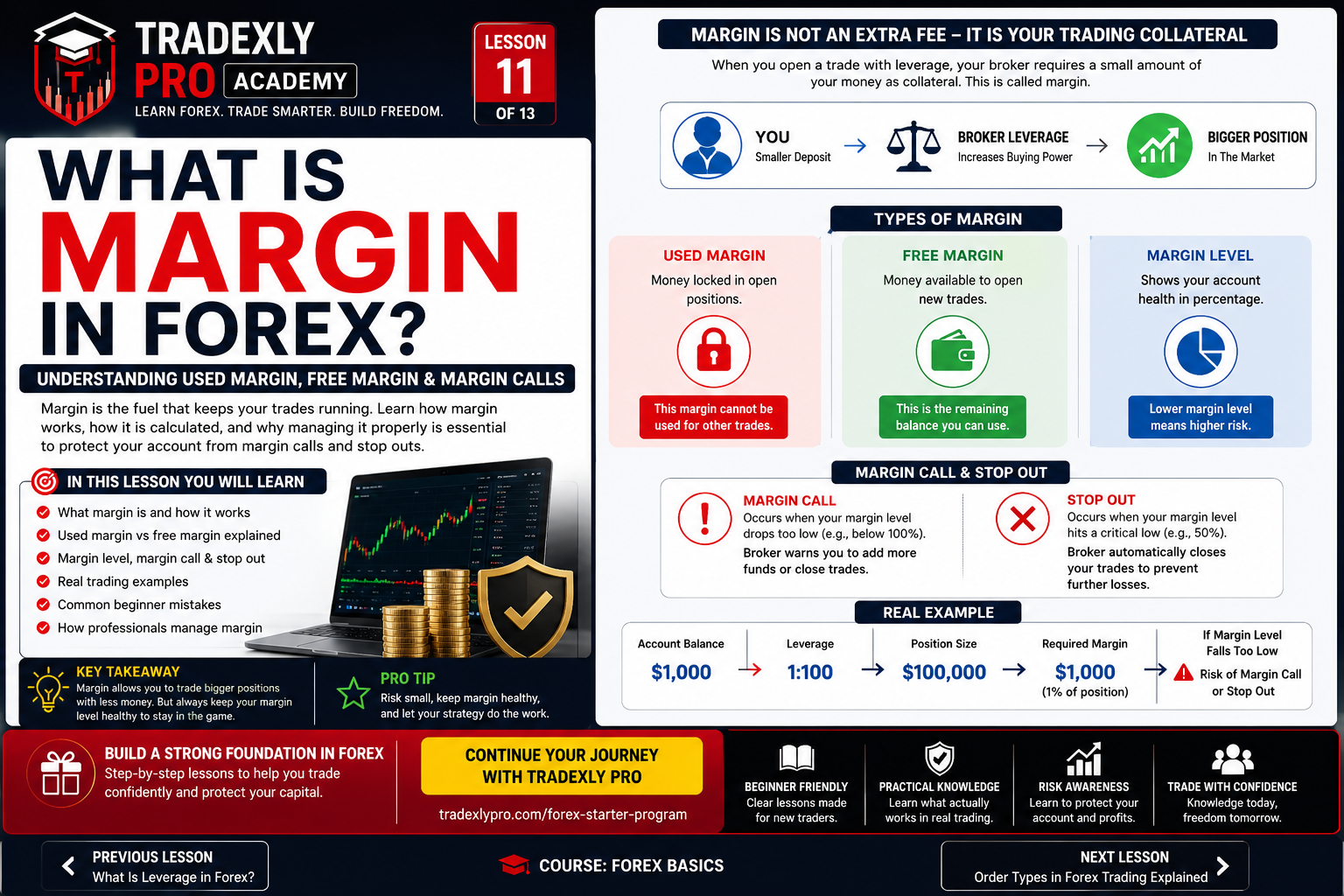
Imagine you want to rent a luxury sports car. The rental company doesn’t ask you to pay the full value of the car before driving it away. Instead, they require a refundable security deposit. That deposit proves you can meet your responsibilities while using the vehicle. Forex margin works in a very similar way. When you open a leveraged trade, your broker doesn’t require you to pay the full value of the position. Instead, a small portion of your account is temporarily set aside as collateral. This amount is called margin.
Did You Know?
Many beginners think margin is an extra fee charged by their broker. It isn’t. Margin is simply a portion of your own money that is reserved while your trade remains open. Once the trade closes, that margin is released back into your account, provided your losses haven’t reduced your account balance.
What Is Margin?
Margin is the amount of money your broker sets aside from your trading account to open and maintain a leveraged position. Think of it as a security deposit. It isn’t a trading fee. It isn’t a commission. And it isn’t money that disappears. Instead, it acts as collateral while your trade is active.
Without margin, brokers couldn’t safely provide leverage because there would be no financial security backing the larger position being controlled.
Simple Definition
Margin is the amount of your own money required to open and maintain a leveraged trade.
Why Does Margin Exist?
Leverage allows traders to control positions that are much larger than their account balance. Because the broker is effectively providing additional buying power, they need assurance that traders can cover potential losses. Margin provides that protection.
Every time you open a leveraged trade, part of your account balance is reserved as margin. As long as the trade remains open, that amount cannot be used to open additional positions. Once the trade closes, the reserved margin becomes available again.
Remember This
Leverage and margin always work together. Leverage increases your buying power. Margin is the collateral that allows your broker to provide that buying power.
How Does Margin Work?
Suppose you have a trading account containing $2,000. Your broker offers leverage of 1:100. You decide to open a position worth $20,000. Instead of paying the full $20,000, your broker may only require a small percentage of that amount as margin. The remaining buying power is made possible through leverage.
Although you’re controlling a much larger position, only a fraction of your account is temporarily locked as margin while the trade remains active. Your remaining funds continue to fluctuate based on profits and losses and may still be available for other trades, depending on your available free margin.
Important
Margin does not protect you from losses. If the market moves against your position, your account balance will still decrease. Margin simply enables leveraged trading—it does not reduce trading risk.
Used Margin vs Free Margin
Once you understand what margin is, the next step is learning how your trading platform manages it. Every time you open a trade, your account automatically divides your available funds into different categories. The two most important are Used Margin and Free Margin. Understanding the difference between these two values is essential because they determine whether you can open additional trades and how close your account is to a margin call.
Used Margin
Used Margin is the portion of your account currently reserved as collateral for your open trades. Think of it as money that is temporarily “locked.” It still belongs to you, but while your trades remain open, it cannot be used to open additional positions.
Free Margin
Free Margin is the amount of money that remains available after your broker has reserved the required margin for your open positions. This is the money you can use to open new trades or absorb temporary losses without immediately risking a margin call.
Simple Way to Remember
- Used Margin = Money currently reserved for open trades.
- Free Margin = Money still available for new opportunities.
A Real Example
Let’s imagine your trading account contains $5,000. You open a leveraged position that requires $800 in margin. Your trading platform may display something similar to this:
| Account Value | Amount |
|---|---|
| Account Balance | $5,000 |
| Used Margin | $800 |
| Free Margin | $4,200 |
Your broker has reserved $800 as collateral. The remaining $4,200 is still available to support your open trade or open additional positions if your trading plan allows.
Did You Know?
Opening another trade usually increases your Used Margin and reduces your Free Margin. Closing trades has the opposite effect—it releases margin back into your account.
What Is Margin Level?
Margin Level is one of the most important indicators on your trading platform. It measures the overall health of your trading account by comparing your available equity with the amount of margin currently being used.
Brokers monitor this percentage to determine whether your account has sufficient funds to support your open positions. The higher your margin level, the healthier your account. The lower it falls, the greater the risk of receiving a margin call.
Margin Level Formula
Margin Level = (Equity ÷ Used Margin) × 100%
Fortunately, you don’t need to calculate this manually. Every modern trading platform updates your margin level automatically in real time as prices move. However, understanding what the number represents will help you make better trading decisions.
Important
A high margin level generally means your account has plenty of available funds. A low margin level indicates your account is becoming stressed and may soon face restrictions if losses continue.
What Is a Margin Call?
A margin call is a warning from your broker that your account no longer has enough available funds to comfortably support your open positions. It happens when your margin level falls below a level determined by your broker.
Think of it as your broker saying:
“Your account is running low on available margin. Unless the situation improves, your positions may have to be closed automatically.”
A margin call doesn’t necessarily mean your trades are closed immediately. Instead, it serves as an alert that your account is approaching a dangerous level.
How Traders Respond
When a margin call occurs, traders usually have several options:
- Add more funds to the trading account.
- Close one or more losing positions.
- Reduce overall market exposure.
- Wait for the market to recover (although this carries additional risk).
What Is a Stop Out?
If losses continue after a margin call and the account’s margin level falls even further, the broker may begin automatically closing open positions. This process is known as a Stop Out.
A Stop Out protects both the trader and the broker by preventing the account balance from falling too far below the required margin. Most brokers begin closing the largest losing positions first until the account returns to a healthier margin level.
Don’t Confuse Margin Calls with Stop Outs
- Margin Call = A warning that your account is under pressure.
- Stop Out = Automatic closure of trades when losses become too large.
Although the exact margin call and stop-out levels vary between brokers, the underlying concept is the same across the Forex industry.
Real Trading Example
Let’s bring all of these concepts together with a realistic trading example. Imagine you have just funded your Forex account and you’re about to place your first trade.
Trading Account
- Account Balance: $10,000
- Leverage: 1:100
- Required Margin for Trade: $1,000
Once your trade opens, your trading platform may display something similar to this:
| Item | Value |
|---|---|
| Balance | $10,000 |
| Used Margin | $1,000 |
| Free Margin | $9,000 |
| Equity | $10,000 |
| Margin Level | 1000% |
At this point, your account is in excellent condition. You have plenty of available funds, your margin level is very high, and your account can comfortably withstand normal market fluctuations.
As the Market Moves…
Suppose the market begins moving against your trade. Your floating loss grows to $600. Although your account balance remains $10,000 because the trade hasn’t been closed yet, your equity changes immediately.
| Item | Value |
|---|---|
| Balance | $10,000 |
| Floating Loss | -$600 |
| Equity | $9,400 |
| Used Margin | $1,000 |
| Free Margin | $8,400 |
| Margin Level | 940% |
Notice something important. Your used margin hasn’t changed. The broker is still reserving the same amount of collateral. What has changed is your equity, because your open trade is currently losing money.
What Happens If Losses Continue?
Imagine the market continues moving against your position. Your floating loss grows larger and larger. As equity falls, your margin level also falls. Eventually your account may look like this:
| Item | Value |
|---|---|
| Balance | $10,000 |
| Floating Loss | -$8,900 |
| Equity | $1,100 |
| Used Margin | $1,000 |
| Free Margin | $100 |
| Margin Level | 110% |
Your account is now under significant pressure. There is very little free margin remaining. If losses continue, your broker may issue a margin call. Should the margin level fall even further, the broker may begin closing your positions automatically to prevent the account from going into a large negative balance.
Remember
Margin calls don’t happen because brokers want to punish traders. They happen because the account no longer has sufficient equity to safely support the open positions. They are designed to protect both the trader and the broker from excessive losses.
How Professional Traders Avoid Margin Calls
Professional traders rarely worry about margin calls because they manage risk long before their account reaches dangerous levels. Rather than using all the buying power available, they leave plenty of free margin available at all times.
Professional Risk Management Habits
- Risk only a small percentage of the account on each trade.
- Always trade with a stop-loss order.
- Avoid opening too many positions at the same time.
- Never use the maximum leverage simply because it is available.
- Maintain healthy free margin as a safety cushion.
- Accept small losses instead of hoping losing trades will recover.
Margin Is Not the Enemy
Many beginners become afraid of margin after hearing stories about margin calls and blown accounts. The truth is that margin itself isn’t dangerous. It is simply a tool that allows leveraged trading to function.
The real danger comes from poor risk management. Opening oversized positions, ignoring stop-loss orders, overtrading, and relying on excessive leverage are what place trading accounts at risk. Used correctly, margin allows traders to participate efficiently in the Forex market while keeping capital available for future opportunities.
Golden Rule
Margin doesn’t create losses. Poor trading decisions do. When combined with sensible position sizing and disciplined risk management, margin becomes a valuable tool rather than a source of danger.
Practice Exercise
Let’s test your understanding of margin with a simple scenario. Imagine you have the following trading account:
- Account Balance: $5,000
- Leverage: 1:100
- Used Margin: $500
- Open Floating Loss: $300
Without using a calculator, answer these questions:
- What is margin?
- Does used margin belong to the broker or to you?
- Would your free margin increase or decrease if you opened another trade?
- What happens to your equity when an open trade loses money?
- What is the difference between a margin call and a stop out?
Challenge Yourself
If you can explain the relationship between leverage, margin, equity, and free margin in your own words, you’ve understood one of the most important concepts in Forex trading. Professional traders don’t just monitor profits—they constantly monitor the health of their trading account.
Frequently Asked Questions
What is margin in Forex?
Margin is the amount of your own money that your broker reserves as collateral when you open a leveraged trade. It is not a fee or a commission—it simply allows you to control a larger position through leverage.
What is the difference between leverage and margin?
Leverage increases your buying power, allowing you to control larger positions. Margin is the amount of money required to access that buying power. The two concepts always work together, but they are not the same thing.
Can I lose my margin?
Your margin itself isn’t charged as a fee. However, if your trade loses money, your account equity decreases. If losses become too large, they can consume the funds in your account, including the amount that was reserved as margin.
What causes a margin call?
A margin call occurs when your account’s margin level falls below your broker’s required threshold because your equity has dropped too far compared to the margin being used. It serves as a warning that your account is under financial pressure.
What is a stop out?
A stop out occurs when your broker automatically closes one or more open positions because your margin level has fallen to a critically low level. This helps prevent your account from falling into a large negative balance.
How can I avoid a margin call?
The best way to avoid a margin call is to manage risk carefully. Use sensible position sizes, place stop-loss orders, avoid overleveraging your account, and maintain sufficient free margin before opening additional trades.
Build a Strong Trading Foundation
Understanding margin is essential for every Forex trader. By learning how leverage, margin, equity, and free margin work together, you’ll be better prepared to manage risk and avoid costly mistakes. Continue through the Tradexly Pro Academy to build the knowledge and confidence needed for long-term trading success.